More About This Card
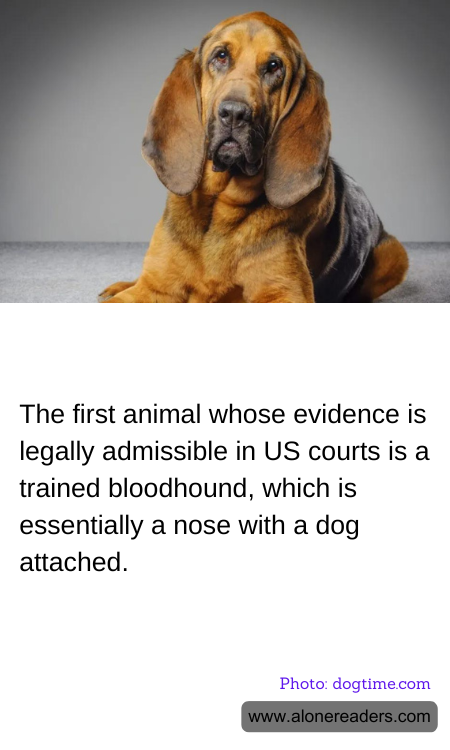
In the realm of legal proceedings, where evidence is meticulously scrutinized and the stakes are often high, the introduction of non-human witnesses might seem like a concept straight out of a fictional courtroom drama. However, in the United States, the keen sense of smell possessed by trained bloodhounds has been recognized as a valuable tool in the pursuit of justice. These remarkable animals, often described as "a nose with a dog attached," have the unique distinction of being the first animals whose evidence is legally admissible in U.S. courts.
Bloodhounds have long been celebrated for their extraordinary olfactory abilities. Their noses are equipped with approximately 300 million scent receptors, compared to a human's mere 5 million. This incredible sense of smell allows them to track scents that are days or even weeks old, making them invaluable in search and rescue operations as well as in criminal investigations. Their ability to follow a trail over long distances and through challenging terrains has earned them a reputation as one of the most effective scent-tracking breeds.
The legal recognition of bloodhound evidence dates back to the late 19th and early 20th centuries. Courts began to accept the testimony of bloodhounds in cases where their tracking abilities could provide crucial leads. This acceptance was not without controversy, as the reliability of animal evidence was initially met with skepticism. However, as more cases demonstrated the accuracy and consistency of bloodhound tracking, their evidence became increasingly accepted in legal circles.
One of the most famous cases involving bloodhound evidence occurred in 1902, when a bloodhound named Nick Carter played a pivotal role in solving a murder case in Kentucky. The dog's ability to track the scent of the suspect led to a conviction, and the case became a landmark in the use of animal evidence in court. Since then, bloodhounds have been used in numerous cases across the country, providing leads and corroborating evidence that have helped solve crimes and bring justice to victims.
Despite their impressive abilities, the use of bloodhound evidence is not without its limitations. Courts typically require that the dogs be trained and handled by experienced professionals to ensure the reliability of their tracking. Additionally, the conditions under which the scent was picked up and the trail followed must be carefully documented to maintain the integrity of the evidence. Judges and juries are often reminded that while bloodhound evidence can be compelling, it should be considered alongside other evidence in a case.
In conclusion, the legal recognition of bloodhound evidence highlights the fascinating intersection of animal abilities and human justice. These remarkable dogs, with their unparalleled sense of smell, continue to play a vital role in law enforcement and the legal system. As science and technology advance, the use of animal evidence may evolve, but the legacy of the bloodhound as a pioneer in this field remains a testament to the unique bond between humans and animals in the pursuit of truth and justice.