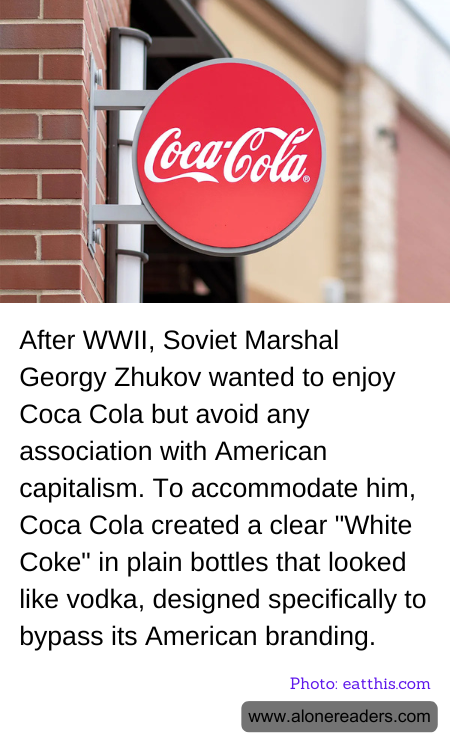
More About This Card
In the aftermath of World War II, the world was not only divided by political ideologies but also by cultural symbols. One such symbol was Coca-Cola, a quintessentially American product that had become synonymous with Western capitalism. However, even in the midst of the Cold War, the allure of this fizzy beverage transcended political boundaries, leading to an intriguing tale involving Soviet Marshal Georgy Zhukov.
Marshal Zhukov, a celebrated military leader who played a pivotal role in the Soviet victory over Nazi Germany, developed a taste for Coca-Cola during his interactions with American forces. Despite his admiration for the drink, Zhukov faced a dilemma. Publicly enjoying Coca-Cola could be seen as an endorsement of American capitalism, something that would not sit well with Soviet ideology. The solution to this conundrum was both creative and discreet.
To accommodate Zhukov's desire to enjoy Coca-Cola without the political implications, the Coca-Cola Company devised a unique solution. They created a special version of the drink that was clear, resembling vodka, a beverage deeply ingrained in Russian culture. This clear version, dubbed "White Coke," was bottled in plain, unbranded containers, allowing Zhukov to enjoy the drink without drawing attention to its American origins.
The creation of White Coke is a fascinating example of how cultural diplomacy can manifest in unexpected ways. It highlights the lengths to which individuals and companies will go to bridge cultural divides, even in times of heightened political tension. The story of White Coke also underscores the universal appeal of certain products, capable of transcending ideological barriers and bringing people together, even if only in private.
While White Coke was a solution tailored specifically for Zhukov, it also serves as a reminder of the complex interplay between politics and consumer culture. It illustrates how, even in an era marked by stark divisions, there were moments of subtle cooperation and mutual understanding. The tale of Zhukov and his clandestine enjoyment of Coca-Cola is a small but telling chapter in the broader narrative of post-war history, where personal preferences occasionally found ways to circumvent the rigid boundaries of political ideology.
Today, the story of White Coke remains a curious footnote in the annals of Cold War history, a testament to the enduring power of cultural symbols and the creative solutions that arise when they intersect with the political landscape. It is a reminder that, sometimes, the simplest pleasures can find a way to thrive, even in the most unlikely of circumstances.