More About This Card
In October 2017, astronomers detected an unusual object passing through our solar system, marking a historic first. Named 'Oumuamua, a Hawaiian term meaning "scout" or "messenger," this object was the first known interstellar visitor to be observed in our cosmic neighborhood. Its discovery sparked widespread interest and debate within the scientific community, not only because of its origin but also due to its peculiar characteristics.
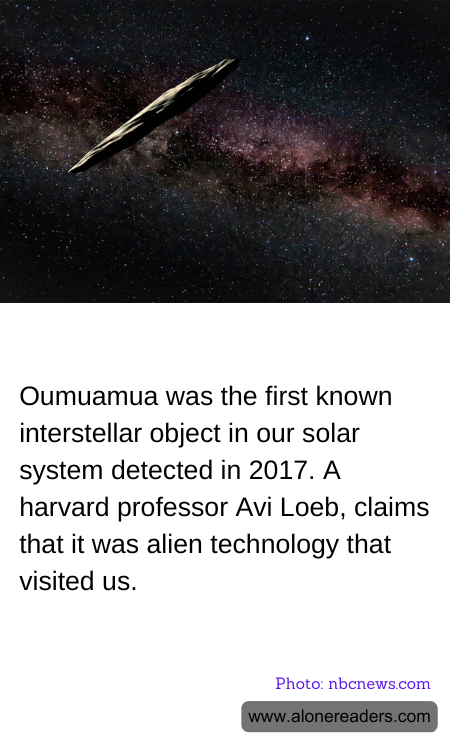
'Oumuamua's trajectory and speed indicated that it originated from outside our solar system, traveling through space for millions of years before its brief encounter with our sun. Unlike typical asteroids or comets, 'Oumuamua exhibited an elongated, cigar-like shape, measuring approximately 800 meters in length but only about 80 meters wide. Its unusual shape and the fact that it did not display a cometary tail, despite its proximity to the sun, puzzled scientists. These anomalies led to various hypotheses about its nature and origin.
One of the most intriguing theories came from Avi Loeb, a prominent Harvard professor and astrophysicist. Loeb proposed that 'Oumuamua might not be a natural object at all but rather a piece of alien technology. He suggested that its unusual shape and the way it accelerated away from the sun could be indicative of a light sail, a form of propulsion that uses radiation pressure from stars to travel through space. This idea, while controversial, captured the imagination of both scientists and the public, reigniting discussions about the possibility of extraterrestrial life and technology.
Loeb's hypothesis was met with skepticism by many in the scientific community, who argued that natural explanations, such as a fragment of a larger body or an unusual comet, were more plausible. However, the lack of definitive evidence left the door open for speculation. The debate highlighted the limitations of our current understanding and the need for more advanced observational technologies to study such interstellar visitors.
The discovery of 'Oumuamua has had a lasting impact on the field of astronomy, prompting the development of new strategies for detecting and studying interstellar objects. It has also inspired a renewed interest in the search for extraterrestrial intelligence, encouraging scientists to consider unconventional possibilities when interpreting data from space.
As we continue to explore the cosmos, 'Oumuamua serves as a reminder of the vastness and mystery of the universe. Whether it was a natural object or an alien artifact, its brief visit to our solar system has expanded our horizons and challenged our perceptions, inviting us to remain curious and open-minded about what lies beyond our celestial doorstep.