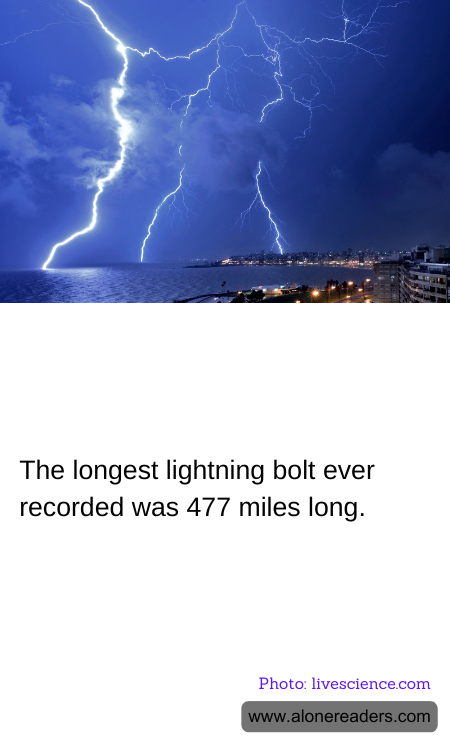
In the realm of natural phenomena, lightning has always captivated human imagination with its dazzling display of power and beauty. Recently, this fascination reached new heights with the recording of the longest lightning bolt ever documented, stretching an astonishing 477 miles across the sky. This record-breaking event not only highlights the extraordinary capabilities of nature but also underscores the importance of understanding and respecting these powerful forces.
This remarkable lightning bolt was recorded on April 29, 2020, over the southern United States, spanning across Mississippi, Louisiana, and Texas. The World Meteorological Organization (WMO) confirmed this feat, surpassing the previous record of 440 miles set in Brazil in 2018. Such a vast distance is equivalent to the length of a flight from New York City to Cleveland, Ohio, illustrating the sheer scale of this natural wonder.
Lightning occurs when there is a buildup of electrical charges within a storm cloud, leading to a sudden discharge of electricity. This discharge can travel vast distances, but the 477-mile bolt is a testament to the extreme conditions that can occur within a thunderstorm. Scientists believe that this extraordinary event was facilitated by a mesoscale convective system, a complex of thunderstorms that can cover large areas and persist for several hours, providing the perfect conditions for such a lengthy lightning strike.
The recording of this lightning bolt was made possible through advancements in satellite technology and ground-based lightning detection networks. These tools allow scientists to track and study lightning with unprecedented accuracy, providing valuable data that can improve weather forecasting and enhance our understanding of storm dynamics. This knowledge is crucial for public safety, as lightning poses significant risks to life and property.
While the record-breaking bolt is a marvel of nature, it also serves as a reminder of the power and unpredictability of thunderstorms. Lightning is a dangerous phenomenon, responsible for numerous injuries and fatalities each year. It is essential for individuals to take precautions during storms, such as seeking shelter indoors and avoiding open fields or tall objects that can attract lightning strikes.
The 477-mile lightning bolt is a testament to the awe-inspiring capabilities of nature and the importance of scientific research in unraveling its mysteries. As technology continues to advance, our ability to study and understand these phenomena will only improve, leading to better preparedness and safety measures. For now, this record-breaking event stands as a remarkable example of the wonders that our planet can produce, inspiring curiosity and respect for the natural world.
