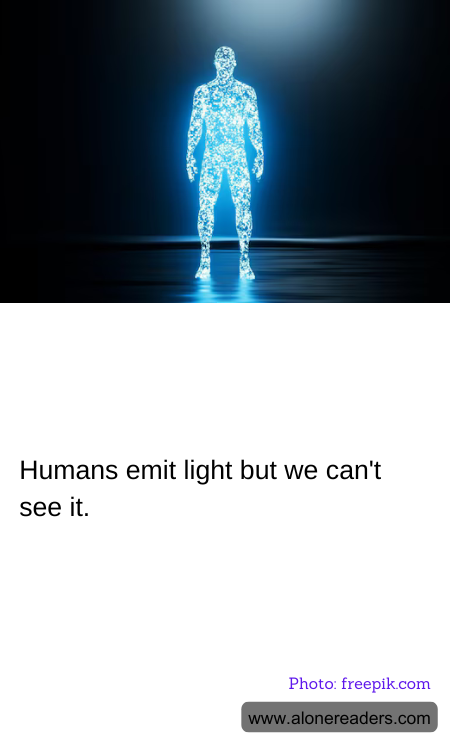
In the realm of science, there are many fascinating phenomena that often go unnoticed in our daily lives. One such intriguing fact is that humans emit light. This might sound like something out of a science fiction novel, but it is a scientifically verified truth. However, the light emitted by humans is not visible to the naked eye, which is why it remains largely unknown to the general public.
The concept of humans emitting light is rooted in the biological processes that occur within our bodies. This light emission is known as bioluminescence, a phenomenon more commonly associated with creatures like fireflies and certain deep-sea fish. In humans, this light is a result of biochemical reactions involving free radicals produced through cellular metabolism. These free radicals interact with lipids and proteins, leading to the emission of photons, or light particles.
Research conducted by Japanese scientists in 2009 provided concrete evidence of this phenomenon. Using ultra-sensitive cameras capable of detecting single photons, the researchers captured images of the faint light emitted by human bodies. Their findings revealed that this light is emitted in a rhythmic pattern, with its intensity fluctuating throughout the day. The light is most intense in the late afternoon and least intense late at night, suggesting a link to the body's metabolic rhythm.
Despite this fascinating discovery, the light emitted by humans is incredibly faint, about 1,000 times less intense than the levels visible to the human eye. This is why we cannot see it without the aid of specialized equipment. The light is emitted across the entire body, but the face, particularly the forehead, cheeks, and neck, tends to emit more light than other areas. This is likely due to the higher concentration of metabolic activity in these regions.
The study of human bioluminescence is not just a curiosity; it holds potential implications for medical science. By understanding the patterns of light emission, researchers hope to develop non-invasive diagnostic tools that could monitor metabolic and oxidative stress levels in the body. This could lead to early detection of diseases or conditions that alter the body's natural metabolic processes.
In conclusion, while humans may not glow like fireflies in the dark, the fact that we emit light is a reminder of the complex and wondrous nature of our biology. It opens up new avenues for scientific exploration and highlights the intricate connections between our bodies and the natural world. As research continues, who knows what other hidden aspects of our biology might be revealed, further illuminating the mysteries of human life.
