More About This Card
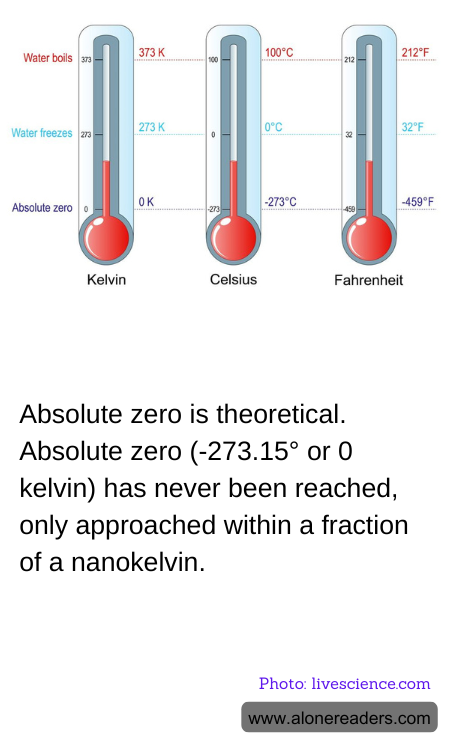
Absolute zero, defined as -273.15 degrees Celsius or 0 Kelvin, represents the lowest possible temperature where all classical motion of particles theoretically ceases. It is a concept that has fascinated scientists for centuries, as it challenges our understanding of thermodynamics and the behavior of matter at extreme conditions. Despite significant advancements in technology and experimental techniques, absolute zero remains an elusive goal, never fully reached but only approached within a fraction of a nanokelvin.
The pursuit of absolute zero is not merely an academic exercise; it has profound implications for our understanding of the universe. At temperatures approaching absolute zero, matter exhibits unique quantum behaviors that are not observable at higher temperatures. For instance, substances can enter a state known as a Bose-Einstein condensate, where particles act in unison as a single quantum entity. This state of matter provides a window into the quantum world, offering insights into the fundamental nature of particles and forces.
Achieving temperatures near absolute zero requires sophisticated equipment and techniques. Scientists use laser cooling and magnetic traps to slow down atoms, reducing their kinetic energy to minuscule levels. These methods have allowed researchers to cool substances to within a few billionths of a degree above absolute zero. However, reaching the exact point of absolute zero is theoretically impossible due to the third law of thermodynamics, which states that as a system approaches absolute zero, the entropy, or disorder, of the system approaches a constant minimum. This law implies that an infinite amount of energy would be required to remove the last vestiges of thermal motion.
The quest to reach absolute zero has led to numerous technological innovations and applications. Ultra-cold temperatures are essential for the development of superconductors, materials that conduct electricity without resistance. These materials have the potential to revolutionize energy transmission and storage, leading to more efficient power grids and advanced electronic devices. Additionally, research at near-absolute zero temperatures contributes to the field of quantum computing, where quantum bits, or qubits, can perform complex calculations far beyond the capabilities of classical computers.
While absolute zero remains a theoretical limit, the journey towards it continues to push the boundaries of science and technology. Each step closer to this ultimate cold provides valuable insights into the quantum realm and opens new possibilities for technological advancements. The pursuit of absolute zero is a testament to human curiosity and ingenuity, driving us to explore the very limits of nature and uncover the mysteries that lie at the heart of the universe.