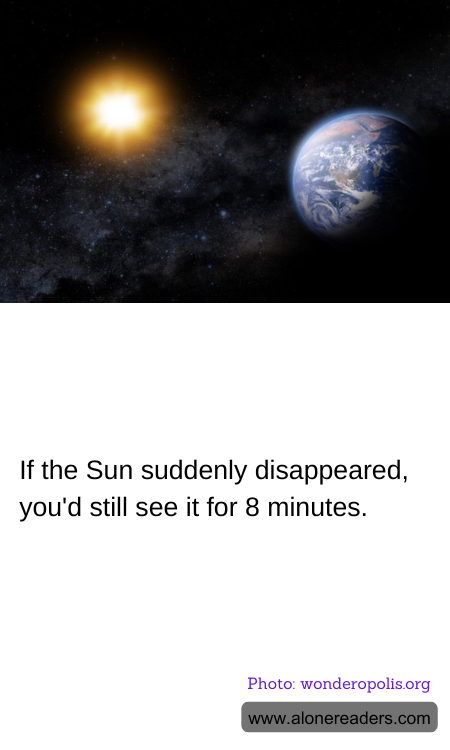
Imagine a scenario where the Sun, the center of our solar system and the source of all life-sustaining energy on Earth, suddenly vanished. While this thought experiment might seem like the stuff of science fiction, it offers a fascinating glimpse into the nature of light and the fundamental laws of physics. If the Sun were to disappear, you might be surprised to learn that we would still see it shining in the sky for approximately eight minutes. This delay is due to the finite speed at which light travels.
Light, despite its incredible speed, does not move instantaneously. It travels at approximately 299,792 kilometers per second (about 186,282 miles per second) in a vacuum. This speed, while mind-bogglingly fast, means that light takes time to travel across vast distances. The average distance from the Earth to the Sun is about 149.6 million kilometers (93 million miles), a span known as an astronomical unit. Given this distance, it takes light roughly eight minutes and 20 seconds to journey from the Sun to Earth.
This delay in light travel time is why we would continue to see the Sun for a short while even after it had disappeared. The last rays of sunlight that left the Sun before its hypothetical disappearance would still be traveling towards Earth, allowing us to bask in its glow for those final eight minutes. During this time, the Earth would continue to orbit the now-absent Sun, as the gravitational effects of the Sun's disappearance would also take eight minutes to reach us, due to the propagation speed of gravitational waves being the same as that of light.
The implications of this delay are profound and highlight the interconnectedness of light, time, and space. It serves as a reminder of the vast scales and distances that govern our universe. The concept of light travel time is not only crucial for understanding astronomical phenomena but also plays a vital role in technologies such as GPS and telecommunications, where precise timing is essential.
While the Sun's sudden disappearance is purely hypothetical, this thought experiment underscores the importance of the Sun in our daily lives and the delicate balance that sustains life on Earth. It also invites us to appreciate the wonders of the universe and the intricate laws of physics that govern it. As we gaze up at the sky, we are not only witnessing the present but also glimpsing into the past, as the light from distant stars and galaxies takes years, centuries, or even millennia to reach us.
In conclusion, the idea that we would continue to see the Sun for eight minutes after its disappearance is a testament to the fascinating nature of light and the universe. It reminds us of the incredible journey that light undertakes to illuminate our world and the profound mysteries that still await our discovery in the cosmos.
