More About This Card
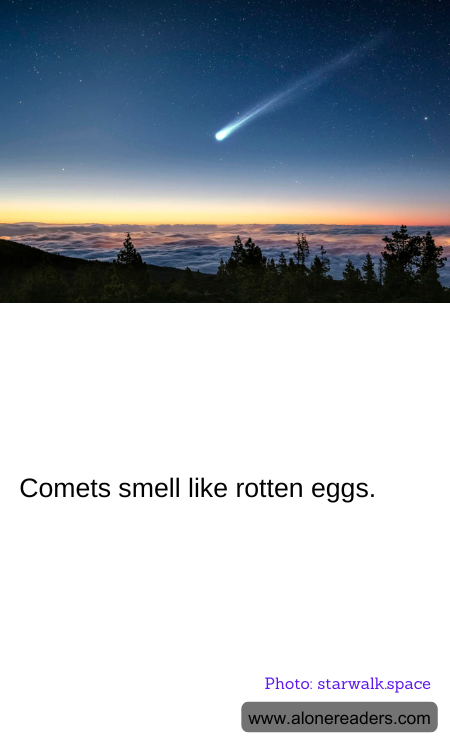
In the vast expanse of space, comets have long fascinated astronomers and the general public alike with their glowing tails and mysterious origins. However, one of the more surprising discoveries about these celestial wanderers is their peculiar smell, often likened to that of rotten eggs. This unusual scent is not just a whimsical observation but is rooted in the chemical composition of comets, providing intriguing insights into their nature and the early solar system.
Comets are essentially cosmic time capsules, composed of ice, dust, and a variety of gases. As they approach the Sun, the heat causes these materials to vaporize, releasing a cloud of gas and dust known as a coma, along with the characteristic tail. Among the gases released are hydrogen sulfide, ammonia, and methane. Hydrogen sulfide, in particular, is responsible for the rotten egg smell. This compound is notorious on Earth for its pungent odor, often associated with decaying organic matter and volcanic activity. When mixed with other gases like ammonia, which has a sharp, pungent smell, the result is a rather unpleasant olfactory experience.
The European Space Agency's Rosetta mission, which studied Comet 67P/Churyumov-Gerasimenko, provided detailed insights into the comet's composition. Instruments aboard the Rosetta spacecraft detected not only hydrogen sulfide but also other volatile compounds such as formaldehyde, methanol, and sulfur dioxide. These findings suggest that comets are complex chemical factories, harboring a rich array of organic molecules. This complexity hints at the role comets may have played in delivering essential ingredients for life to Earth billions of years ago.
While the notion of a comet smelling like rotten eggs might seem amusing, it underscores the importance of studying these ancient objects. Comets are remnants from the early solar system, and their composition offers clues about the conditions and processes that prevailed during its formation. By understanding what comets are made of, scientists can piece together the history of our cosmic neighborhood and the potential for life elsewhere in the universe.
For those who dream of space travel, the idea of encountering a comet's stench might be a deterrent. However, it's important to note that the vacuum of space means these smells wouldn't be detectable without the aid of scientific instruments. On Earth, we rely on these instruments to translate the chemical signatures of distant objects into familiar terms, like scent, to help us comprehend the alien environments of our solar system.
In conclusion, the discovery that comets smell like rotten eggs is more than just a quirky fact; it is a window into the complex chemistry of these celestial bodies. As we continue to explore the cosmos, each new finding adds to our understanding of the universe and our place within it. Whether through the lens of a telescope or the nose of a spacecraft, comets continue to captivate and educate, reminding us of the wonders that lie beyond our world.