More About This Card
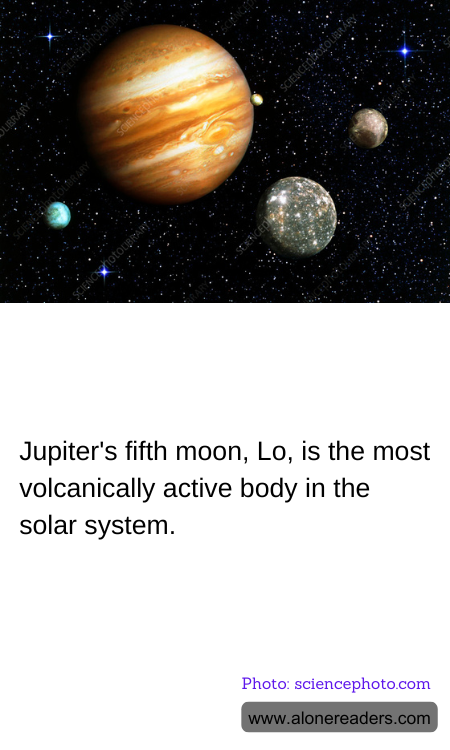
Jupiter's fifth moon, Io, stands out as a celestial wonder, captivating scientists and astronomy enthusiasts alike with its extraordinary volcanic activity. As the most volcanically active body in our solar system, Io offers a unique glimpse into the dynamic processes that shape planetary bodies. This small yet fascinating moon, slightly larger than Earth's moon, orbits Jupiter at a distance of approximately 422,000 kilometers, completing its orbit in just 1.77 Earth days.
Io's volcanic activity is driven by the intense gravitational interactions between itself, Jupiter, and the neighboring moons, Europa and Ganymede. This gravitational tug-of-war generates immense tidal forces that flex Io's interior, producing heat through friction. The result is a molten interior that fuels hundreds of active volcanoes on its surface. These volcanoes are capable of producing plumes that can reach heights of up to 500 kilometers, spewing sulfur and sulfur dioxide into space and painting Io's surface with vibrant hues of yellow, red, and orange.
The surface of Io is a constantly changing landscape, with lava flows, volcanic pits, and mountains that can rise up to 17 kilometers high. The relentless volcanic activity continuously reshapes the moon's surface, erasing impact craters that are commonly found on other celestial bodies. This makes Io a living laboratory for scientists studying planetary geology and the processes that drive volcanic activity.
Io's extreme environment presents challenges for exploration, but it also offers valuable insights into the nature of volcanic activity beyond Earth. The study of Io helps scientists understand the potential for volcanic activity on other moons and planets, particularly those with subsurface oceans or icy crusts. By examining Io's volcanic processes, researchers can draw parallels to early Earth and the role of volcanism in shaping our own planet's evolution.
Despite its harsh conditions, Io remains a target of interest for future missions. The potential for robotic exploration could unlock further secrets about its interior and the mechanisms driving its volcanic activity. As technology advances, the prospect of sending spacecraft to Io becomes more feasible, promising to expand our understanding of this remarkable moon and its place in the solar system.
In conclusion, Io's status as the most volcanically active body in the solar system makes it a focal point for scientific inquiry and exploration. Its dynamic surface and the forces that drive its volcanic activity offer a window into the processes that have shaped not only Io but also other planetary bodies. As we continue to explore the mysteries of our solar system, Io stands as a testament to the power and complexity of celestial mechanics and geological activity.