More About This Card
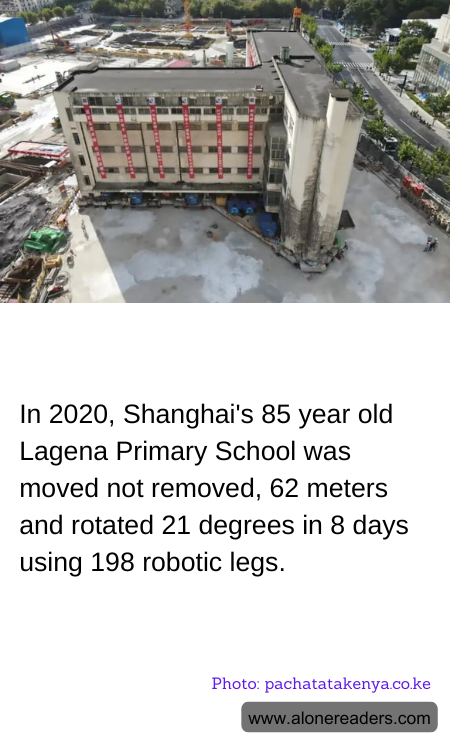
In the bustling metropolis of Shanghai, a remarkable feat of engineering took place in 2020 that captured the attention of the world. The Lagena Primary School, an 85-year-old historical building, was not demolished to make way for new developments, as is often the case with aging structures in rapidly growing cities. Instead, it was carefully moved 62 meters and rotated 21 degrees over the course of eight days, thanks to an innovative approach involving 198 robotic legs.
This extraordinary project was undertaken to preserve the architectural heritage of the school while accommodating urban development. The decision to relocate rather than demolish the building reflects a growing trend in China and other parts of the world to balance modernization with the preservation of history. The Lagena Primary School, with its rich history and cultural significance, was deemed too valuable to lose.
The process of moving the school was a marvel of modern engineering. Engineers employed a cutting-edge technology known as the "walking machine" method. This involved the use of 198 robotic legs, which were strategically placed under the building. These robotic legs mimicked the human walking motion, allowing the structure to be lifted and moved with precision. The entire building was carefully monitored and controlled, ensuring that it remained stable throughout the journey.
The relocation of the Lagena Primary School was not only a technical achievement but also a testament to the value placed on historical preservation. By choosing to move the building, the city of Shanghai demonstrated a commitment to maintaining its cultural landmarks while still embracing progress. This project serves as an inspiring example of how technology can be harnessed to protect and preserve our shared heritage.
For the residents of Shanghai and the students of Lagena Primary School, the successful relocation was a cause for celebration. It allowed the school to continue serving its educational purpose in a new location without losing its historical essence. The project also sparked interest and admiration from around the world, showcasing the potential of innovative engineering solutions in urban planning.
In a world where the past often gives way to the future, the story of the Lagena Primary School stands out as a reminder that history and progress can coexist. By moving rather than removing this cherished building, Shanghai has set a precedent for other cities facing similar challenges. It is a powerful message that with creativity and technology, we can build a future that honors our past.