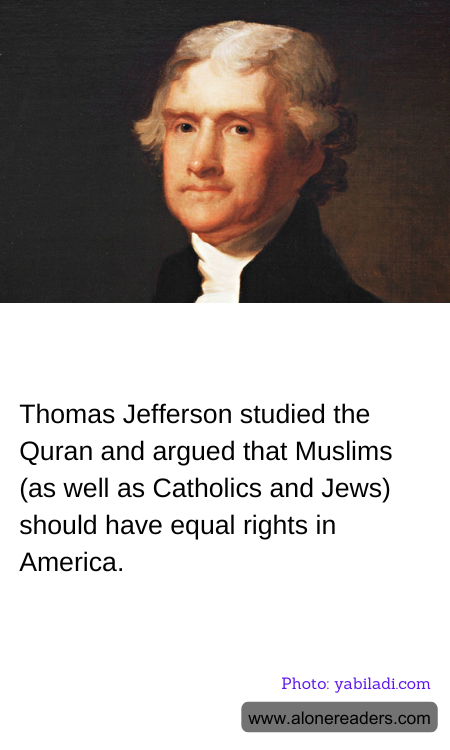
Thomas Jefferson, one of the founding fathers of the United States and the principal author of the Declaration of Independence, is often celebrated for his commitment to religious freedom and equality. His advocacy for the rights of individuals to practice their faith without interference from the state extended beyond the dominant Protestant denominations of his time. Jefferson's engagement with religious texts, including the Quran, underscores his belief in the importance of religious tolerance and the inclusion of diverse faiths in the American fabric.
Jefferson's study of the Quran was not merely an academic exercise but a reflection of his broader philosophical commitment to understanding and respecting different cultures and religions. In an era when Islam was largely misunderstood and often viewed with suspicion, Jefferson's willingness to engage with Islamic texts demonstrated an openness that was ahead of his time. His personal library, which included a copy of the Quran, symbolized his belief in the necessity of knowledge and understanding as tools for fostering tolerance.
Jefferson's advocacy for religious freedom was enshrined in his drafting of the Virginia Statute for Religious Freedom in 1777, which became law in 1786. This statute laid the groundwork for the First Amendment to the U.S. Constitution, which guarantees freedom of religion. Jefferson argued that religious liberty should extend to all individuals, regardless of their faith. He believed that Muslims, Catholics, Jews, and adherents of other religions should enjoy the same rights and protections as Protestant Christians.
This inclusive vision was not without its challenges. In the early years of the American republic, religious minorities often faced discrimination and prejudice. However, Jefferson's principles provided a foundation for the gradual expansion of religious rights. His insistence on the separation of church and state was a radical idea at the time, yet it has become a cornerstone of American democracy, ensuring that individuals can practice their faith freely without fear of government interference.
Jefferson's legacy in promoting religious equality is a testament to his belief in the fundamental rights of all individuals. His study of the Quran and his advocacy for the rights of Muslims, alongside Catholics and Jews, highlight his commitment to a pluralistic society where diversity is not only tolerated but embraced. As America continues to grapple with issues of religious freedom and inclusion, Jefferson's vision remains a guiding light, reminding us of the importance of understanding and respecting the beliefs of others.
In today's world, where religious intolerance and discrimination still persist, Jefferson's example serves as a powerful reminder of the values upon which the United States was founded. His dedication to religious equality and his willingness to engage with diverse perspectives continue to inspire efforts to build a more inclusive and harmonious society.
