More About This Card
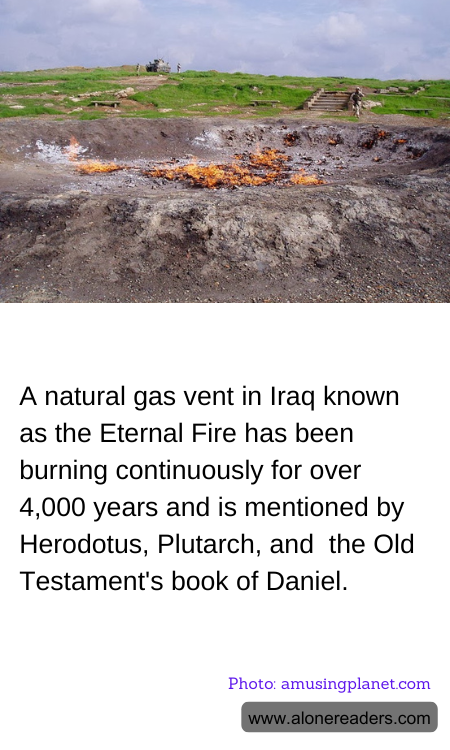
In the heart of Iraq, amidst the ancient landscapes that have witnessed the rise and fall of civilizations, lies a natural wonder that has captivated human imagination for millennia. Known as the Eternal Fire, this natural gas vent has been burning continuously for over 4,000 years. Its unyielding flames have not only withstood the test of time but have also found their place in the annals of history, being mentioned by notable figures such as Herodotus, Plutarch, and even in the Old Testament's book of Daniel.
The Eternal Fire is located near the modern city of Kirkuk, in an area rich with natural gas reserves. This phenomenon is a result of natural gas seeping through the earth's crust and igniting upon contact with the air. The flames, which dance perpetually, have served as a beacon of wonder and mystery, drawing the curious and the devout alike. For the ancient peoples of Mesopotamia, the Eternal Fire was more than just a natural occurrence; it was a symbol of divine presence and power.
Herodotus, the Greek historian often referred to as "The Father of History," wrote about the Eternal Fire in his accounts of the region. His writings, which date back to the 5th century BCE, describe the flames as a marvel of the natural world, a testament to the earth's hidden energies. Similarly, Plutarch, the Greek biographer and essayist, mentioned the fire in his works, further cementing its place in the cultural and historical tapestry of the ancient world.
The Eternal Fire also finds a mention in the Old Testament's book of Daniel. The story of Shadrach, Meshach, and Abednego, who were thrown into a fiery furnace by King Nebuchadnezzar yet emerged unscathed, is thought by some scholars to be inspired by the perpetual flames of the Eternal Fire. This biblical connection adds a layer of spiritual significance to the site, making it a place of pilgrimage for those seeking to connect with the divine.
Today, the Eternal Fire continues to burn, a living relic of the past that bridges the gap between ancient history and the modern world. It stands as a reminder of the earth's enduring power and the stories that have shaped human civilization. For visitors, the Eternal Fire offers a glimpse into a world where nature and mythology intertwine, creating a narrative that has transcended generations.
As we marvel at this natural wonder, we are reminded of the timelessness of the earth's phenomena and the enduring legacy of those who have chronicled its mysteries. The Eternal Fire, with its unceasing flames, remains a symbol of continuity and resilience, a testament to the enduring spirit of the land and its people.