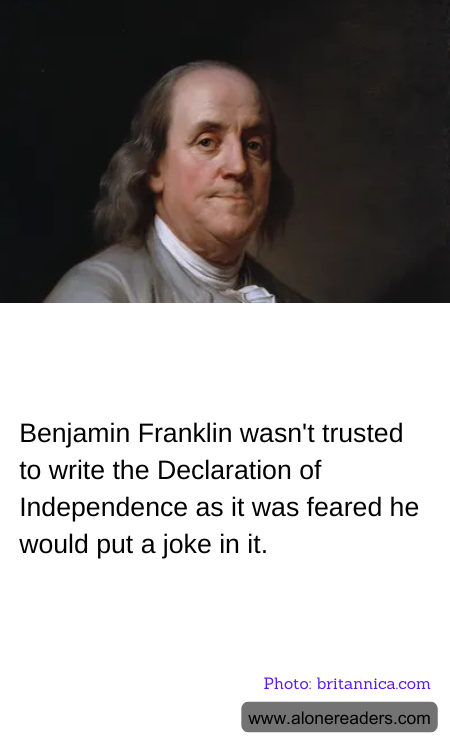
Benjamin Franklin, one of the most revered figures in American history, was a man of many talents—an inventor, statesman, diplomat, and philosopher. However, despite his numerous contributions to the founding of the United States, Franklin was not entrusted with drafting the Declaration of Independence. The reason for this decision is both intriguing and amusing: it was feared that Franklin might insert a joke into this pivotal document.
The Continental Congress, convened in 1776, was tasked with the momentous responsibility of declaring independence from British rule. A committee of five was appointed to draft the Declaration, including Thomas Jefferson, John Adams, Benjamin Franklin, Roger Sherman, and Robert R. Livingston. While Franklin was undoubtedly one of the most intelligent and capable members of this group, the task of writing the first draft was given to the young and eloquent Thomas Jefferson.
Franklin's reputation as a humorist was well-known among his peers. His wit and penchant for satire were evident in his writings, such as the famous "Poor Richard's Almanack," which was filled with clever aphorisms and humorous observations. His contemporaries admired his ability to use humor to convey serious messages, but they also recognized that the Declaration of Independence required a tone of gravity and solemnity. The fear that Franklin might inject humor into the document, perhaps in the form of a sly remark or a witty aside, led the committee to assign the drafting to Jefferson, who was known for his eloquent and serious prose.
Despite not being the principal author, Franklin's influence on the Declaration was significant. He reviewed Jefferson's draft and made several important edits, ensuring that the document was both powerful and precise. His contributions helped shape the final version, which eloquently articulated the colonies' reasons for seeking independence and laid the foundation for a new nation. Franklin's role in the creation of the Declaration, though not as prominent as Jefferson's, was nonetheless crucial.
The anecdote about Franklin's potential for humor serves as a reminder of the multifaceted nature of historical figures. It highlights the balance between levity and seriousness that Franklin embodied throughout his life. While he may not have penned the Declaration, his wisdom, wit, and diplomatic skills were instrumental in the founding of the United States. Franklin's legacy endures not only in the documents and institutions he helped create but also in the enduring spirit of innovation and humor that he championed.
