More About This Card
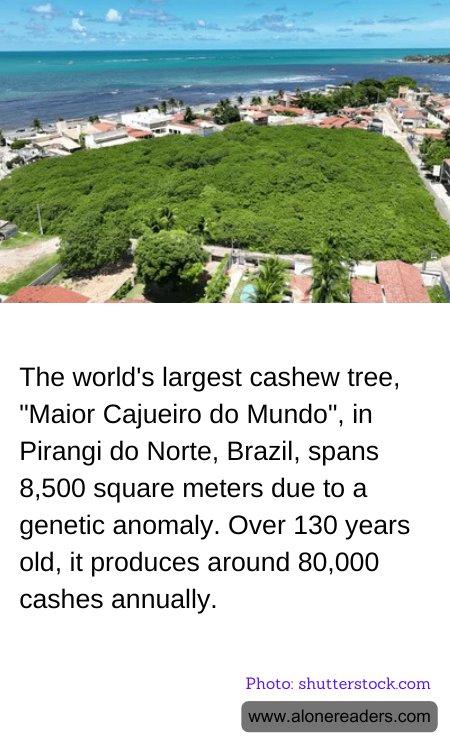
Nestled in the coastal town of Pirangi do Norte, Brazil, stands a botanical marvel that has captivated the attention of both locals and tourists alike. Known as the "Maior Cajueiro do Mundo," this extraordinary cashew tree holds the title of the world's largest, sprawling across an impressive 8,500 square meters. Its vast canopy, which resembles a small forest, is the result of a unique genetic anomaly that has allowed it to grow in such an expansive manner.
The tree's story began over 130 years ago when it was first planted. Unlike typical cashew trees, which grow upwards, this particular tree's branches have the unusual ability to grow outwards and then bend down to the ground. Once they touch the soil, these branches take root and sprout new growth, effectively creating a network of interconnected trunks. This peculiar growth pattern has enabled the tree to cover an area equivalent to nearly two football fields, making it a natural wonder and a significant tourist attraction.
Each year, the "Maior Cajueiro do Mundo" produces approximately 80,000 cashews, a testament to its vitality and the richness of the Brazilian soil. The tree not only serves as a source of delicious nuts but also plays a crucial role in the local ecosystem, providing habitat and food for various species of birds and insects. Its sprawling branches offer a shaded sanctuary for visitors seeking respite from the tropical sun, while its lush foliage creates a serene environment for nature lovers.
The tree's significance extends beyond its biological and ecological contributions. It has become a symbol of the region's cultural heritage and a point of pride for the community. Efforts have been made to preserve and protect this natural wonder, ensuring that it continues to thrive for future generations to admire. Local authorities have implemented measures to manage the influx of tourists, balancing the need for conservation with the economic benefits that tourism brings to the area.
Visitors to the "Maior Cajueiro do Mundo" are often struck by its sheer size and the sense of tranquility it imparts. Walking beneath its vast canopy, one can't help but feel a connection to nature and a sense of awe at the wonders of genetic diversity. The tree stands as a reminder of the incredible adaptability of life and the beauty that can arise from nature's anomalies.
In a world where natural wonders are increasingly threatened by human activity, the "Maior Cajueiro do Mundo" serves as a beacon of hope and a call to action for conservation efforts. It invites us to appreciate the unique and the extraordinary, urging us to protect the natural world so that such wonders may continue to inspire and delight for generations to come.