More About This Card
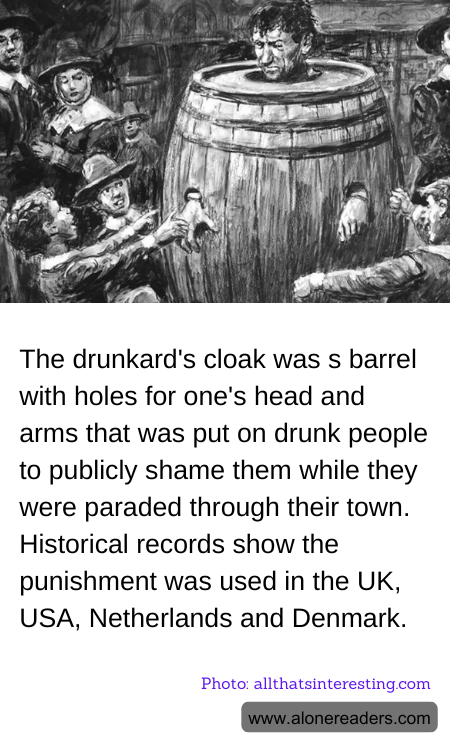
In the annals of history, societies have often devised unique and sometimes harsh methods to maintain order and discipline. One such method, known as the "drunkard's cloak," stands out for its peculiar and public nature. This form of punishment was employed to shame individuals who were found guilty of public intoxication. The drunkard's cloak was essentially a barrel with holes cut out for the head and arms, transforming it into a wearable contraption that served as a mobile pillory. Those subjected to this punishment were paraded through their towns, serving as a living cautionary tale against the perils of excessive drinking.
The origins of the drunkard's cloak can be traced back to the 16th and 17th centuries, a period when public shaming was a common disciplinary tactic. Historical records indicate that this punishment was used in several countries, including the United Kingdom, the United States, the Netherlands, and Denmark. Each of these regions had its own variations and nuances, but the core idea remained the same: to publicly humiliate the offender and deter others from similar behavior.
In the United Kingdom, the drunkard's cloak was often employed in bustling towns and cities where public drunkenness was seen as a significant social problem. The sight of an individual struggling to maintain balance while encased in a cumbersome barrel was intended to provoke both laughter and scorn from onlookers. This public spectacle not only served as a deterrent but also reinforced societal norms regarding acceptable behavior.
Across the Atlantic, in the early American colonies, the drunkard's cloak was similarly utilized. The Puritans, known for their strict moral codes, saw public intoxication as a vice that needed to be curbed. The use of the drunkard's cloak in these communities reflected a broader trend of using public humiliation as a tool for social control. It was believed that the shame associated with being paraded in such a manner would encourage individuals to reform their ways.
In the Netherlands and Denmark, the drunkard's cloak was part of a broader array of public punishments designed to maintain order in rapidly growing urban centers. These societies, like their counterparts in the UK and USA, recognized the disruptive potential of public drunkenness and sought to address it through visible and memorable means.
While the drunkard's cloak may seem archaic by today's standards, it offers a fascinating glimpse into the past and the lengths to which societies have gone to enforce conformity and discourage undesirable behavior. As we reflect on these historical practices, it is important to consider how societal attitudes towards punishment and rehabilitation have evolved. Today, the focus is more on understanding the underlying causes of such behaviors and addressing them through education and support rather than public humiliation.
The legacy of the drunkard's cloak serves as a reminder of the ever-changing landscape of societal norms and the continuous quest for balance between justice and compassion.