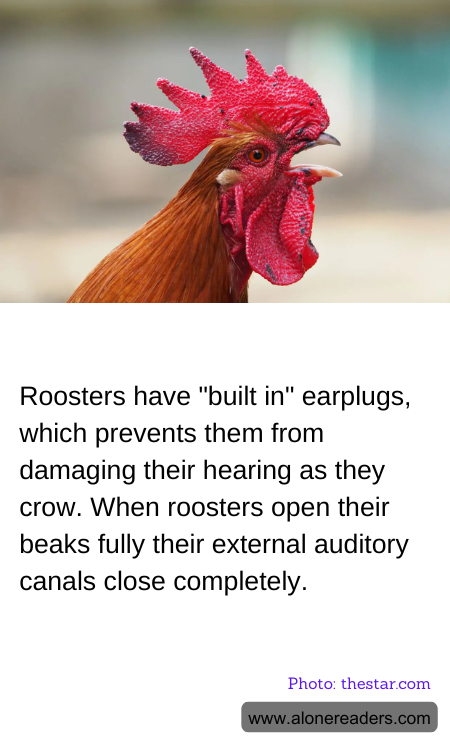
Roosters are known for their early morning calls, a sound that can be heard echoing across farms and rural landscapes. While their crowing is a familiar and often charming aspect of rural life, it raises an interesting question: how do roosters manage to protect their hearing from the loudness of their own calls? Remarkably, nature has equipped these birds with a fascinating adaptation that acts as a natural safeguard against potential hearing damage.
When a rooster crows, it can reach sound levels of up to 100 decibels, which is comparable to the noise of a chainsaw or a jackhammer. Such intense noise levels could potentially damage hearing over time, but roosters have a unique anatomical feature that prevents this. As a rooster opens its beak to crow, its external auditory canals close completely. This action effectively acts as a built-in earplug, protecting the bird's sensitive inner ear from the loudness of its own voice.
This natural mechanism is a brilliant example of evolutionary adaptation. The closure of the auditory canals is facilitated by the movement of the rooster's jaw and the surrounding muscles. When the beak is fully open, the ear canal is sealed off, preventing the sound waves from entering and causing harm. This ingenious design ensures that roosters can continue their crowing without risking their hearing, allowing them to fulfill their role as natural alarm clocks without any adverse effects.
The discovery of this adaptation not only highlights the wonders of evolution but also provides insight into the complex ways animals have evolved to protect themselves from environmental challenges. It serves as a reminder of the intricate balance of nature and the remarkable solutions it has developed to ensure the survival and well-being of various species.
For those who live near roosters or keep them as part of their farm, understanding this natural adaptation can foster a greater appreciation for these birds. It also underscores the importance of preserving natural habitats where such fascinating behaviors can be observed and studied. As we continue to learn more about the natural world, the story of the rooster's built-in earplugs stands as a testament to the marvels of nature and the incredible adaptations that have evolved over time.
