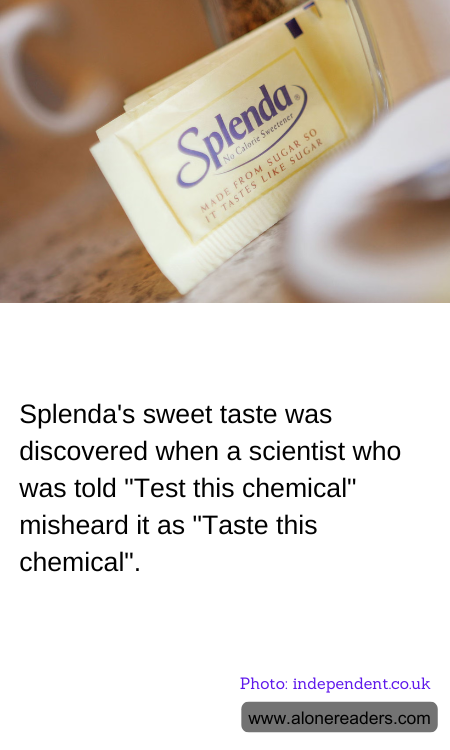
In the world of scientific discovery, serendipity often plays a crucial role, leading to breakthroughs that transform industries and everyday life. One such serendipitous moment occurred in the late 1970s, leading to the creation of Splenda, a popular sugar substitute. The story begins in a laboratory at Queen Elizabeth College in London, where a young Indian chemist named Shashikant Phadnis was working under the guidance of Professor Leslie Hough.
The team was engaged in research focused on developing new insecticides, and their work involved synthesizing various chemical compounds. During one of their experiments, Professor Hough instructed Phadnis to "test" a particular chlorinated sugar compound. However, due to a misunderstanding, Phadnis heard the word "taste" instead of "test." Trusting his instincts, he decided to taste the compound, a decision that would prove to be fortuitous.
To his surprise, the compound had an exceptionally sweet taste, far sweeter than regular sugar. This unexpected discovery piqued the interest of the research team, prompting them to investigate further. They found that the compound, later named sucralose, was not only intensely sweet but also had the advantage of being calorie-free and stable under heat, making it an ideal candidate for use as a sugar substitute.
The discovery of sucralose marked a significant milestone in the food industry. It offered a new way for people to enjoy the sweetness they loved without the calories associated with sugar. This was particularly appealing to those managing their weight or dealing with conditions like diabetes, where sugar intake needs to be carefully monitored. The compound was eventually commercialized under the brand name Splenda, and it quickly gained popularity around the world.
Splenda's journey from a laboratory mishap to a household staple is a testament to the unpredictable nature of scientific research. It highlights the importance of curiosity and open-mindedness in the pursuit of knowledge. The story also underscores the potential for unexpected outcomes to lead to innovations that can have a profound impact on society.
Today, Splenda is used in a wide range of products, from beverages to baked goods, providing a sweet alternative for millions of people. Its success is a reminder of how a simple miscommunication in a lab can lead to a discovery that changes the way we live. As we continue to explore the boundaries of science and technology, stories like that of Splenda inspire us to remain open to the unexpected and to embrace the possibilities that arise from chance encounters.
