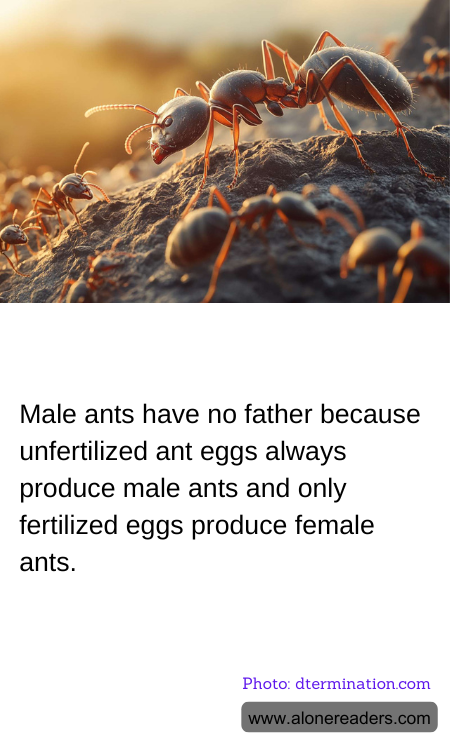
In the fascinating world of ants, a unique aspect of their biology sets them apart from many other creatures: male ants have no fathers. This intriguing phenomenon is rooted in the reproductive system of ants, which is based on a mechanism known as haplodiploidy. This system determines the sex of the offspring based on whether the eggs are fertilized or not.
In ant colonies, the queen is the central reproductive figure. She has the remarkable ability to control the fertilization of her eggs. When a queen ant lays an unfertilized egg, it develops into a male ant, also known as a drone. These male ants are haploid, meaning they have only one set of chromosomes, which they inherit solely from their mother. This is because the egg does not combine with any sperm to form a fertilized zygote. Consequently, male ants have no genetic contribution from a father, as they are born from eggs that have not been fertilized.
In contrast, when the queen lays a fertilized egg, it develops into a female ant, which can be either a worker or a future queen. These female ants are diploid, possessing two sets of chromosomes—one from the mother and one from the father. The fertilization process involves the fusion of the egg with sperm stored by the queen from her mating flights, which typically occur once in her lifetime. This dual genetic contribution results in the diverse and complex social structures observed in ant colonies, where female ants perform various roles essential for the colony's survival and growth.
The absence of a paternal lineage for male ants is a fascinating aspect of their biology, highlighting the efficiency and specialization of ant colonies. Male ants primarily exist to mate with virgin queens from other colonies, ensuring genetic diversity and the continuation of the species. After fulfilling their reproductive role, male ants generally have a short lifespan and do not contribute to the daily tasks within the colony.
This reproductive strategy is not only efficient but also ensures that the colony can rapidly expand and adapt to environmental changes. By producing males only when necessary, the colony can focus its resources on nurturing the female workers and future queens, who are vital for the colony's maintenance and expansion.
Understanding the reproductive dynamics of ants provides insight into the complex and highly organized societies these insects form. It also underscores the remarkable adaptability and evolutionary success of ants, which have thrived for millions of years. The fact that male ants have no fathers is just one of the many wonders of the natural world, offering a glimpse into the intricate mechanisms that govern life on Earth.
