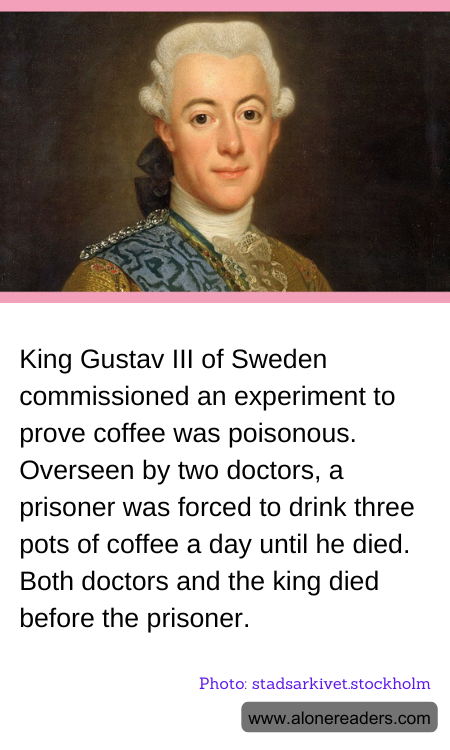
In the annals of history, there are tales that blend the bizarre with the scientific, and one such story involves King Gustav III of Sweden and his peculiar experiment with coffee. In the late 18th century, coffee was a relatively new beverage in Europe, and its effects were the subject of much debate. Some hailed it as a miraculous elixir, while others feared it as a dangerous poison. King Gustav III, a monarch with a keen interest in science and a penchant for the dramatic, decided to settle the matter once and for all with an experiment that would be remembered for its unusual approach.
The king's plan was simple yet morbidly fascinating. He sought to prove coffee's supposed toxicity by observing its effects on a human subject. To this end, he selected a prisoner who had been sentenced to death, offering him a chance to escape execution in exchange for participating in the experiment. The prisoner was required to consume three pots of coffee every day until the beverage's alleged lethal effects took their toll. To ensure the experiment's integrity, King Gustav appointed two physicians to oversee the process and monitor the prisoner's health.
As the days turned into weeks and the weeks into months, the prisoner continued to drink his daily allotment of coffee, seemingly unaffected by the copious amounts he consumed. Meanwhile, the experiment took an unexpected turn. Both doctors, tasked with observing the prisoner, passed away from natural causes before any conclusive results could be drawn. In a twist of fate, King Gustav III himself was assassinated in 1792, leaving the experiment without its royal patron.
Remarkably, the prisoner outlived all those who had orchestrated the experiment. He continued to drink his daily coffee, ultimately surviving well beyond the deaths of the king and the doctors. The experiment, intended to demonstrate the dangers of coffee, inadvertently highlighted the beverage's relative harmlessness, at least in the context of the quantities consumed by the prisoner.
This peculiar chapter in history serves as a reminder of the lengths to which people have gone in the pursuit of scientific knowledge, even when driven by misconceptions. King Gustav III's coffee experiment, though flawed in its design and execution, inadvertently contributed to the growing acceptance of coffee as a safe and popular beverage. Today, coffee is enjoyed by millions around the world, its reputation as a poison long forgotten, thanks in part to the unintended legacy of a king's curious endeavor.
