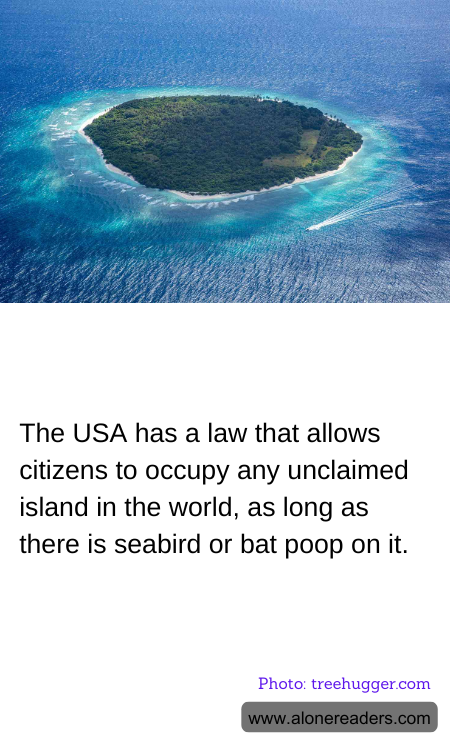
In the annals of quirky American laws, few are as peculiar and intriguing as the Guano Islands Act of 1856. This little-known piece of legislation allows U.S. citizens to claim uninhabited islands around the world, provided they contain deposits of guano, which is the accumulated excrement of seabirds or bats. While this might sound like an odd basis for territorial expansion, the law was born out of necessity and economic interest during a time when guano was a highly sought-after commodity.
In the mid-19th century, guano was prized as a potent fertilizer, rich in nitrogen, phosphate, and potassium—essential nutrients for agriculture. The booming agricultural industry in the United States was in dire need of such fertilizers to enhance crop yields. Recognizing the economic potential, Congress passed the Guano Islands Act, which empowered American citizens to take possession of any unclaimed guano-rich islands on behalf of the United States. Once claimed, these islands could be mined for their valuable deposits, fueling the agricultural engine of the nation.
The act essentially turned adventurous Americans into explorers and entrepreneurs, setting off on expeditions to remote corners of the globe in search of these guano-covered treasures. Over the years, numerous islands in the Pacific and Caribbean were claimed under this law, expanding the reach of the United States, albeit temporarily in many cases. Some of these islands, like Navassa Island in the Caribbean, remain U.S. territories to this day, though the guano industry has long since waned.
While the Guano Islands Act may seem like a relic of a bygone era, it remains on the books, a testament to a time when the U.S. was eager to expand its influence and resources. The law is a fascinating example of how economic needs can drive legal innovation, even if the results are as unusual as claiming islands based on bird droppings. Today, the act is more of a historical curiosity than a practical tool, as most guano-rich islands have been claimed, and synthetic fertilizers have largely replaced natural guano.
Nevertheless, the Guano Islands Act serves as a reminder of the lengths to which nations will go to secure resources and the sometimes peculiar paths history takes. It also highlights the ever-evolving relationship between law, economics, and the environment. While the days of guano-fueled expansion are over, the story of this unique law continues to capture the imagination, offering a glimpse into a time when seabird and bat droppings were seen as a gateway to prosperity.
