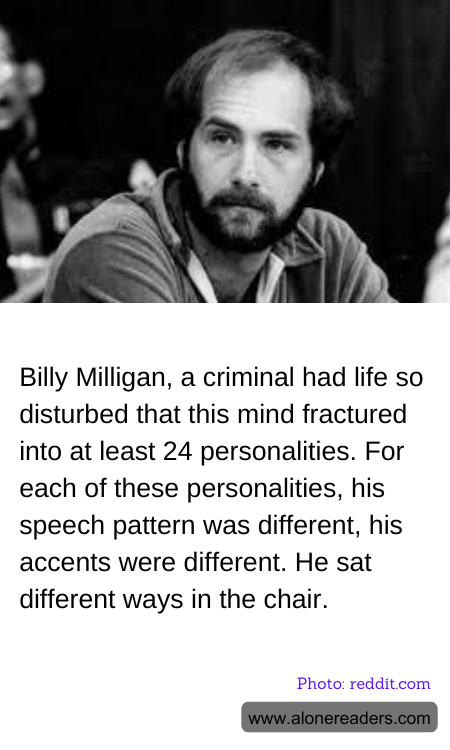
Billy Milligan's life is a haunting tale of a mind shattered into fragments, each piece representing a distinct personality. His story became a landmark case in the annals of criminal history and psychology, illustrating the profound effects of trauma on the human psyche. Milligan was diagnosed with dissociative identity disorder (DID), a condition that led him to develop at least 24 separate personalities, each with its own unique characteristics.
These personalities were not mere figments of imagination but fully formed identities with their own voices, accents, and mannerisms. For instance, Arthur, an Englishman, spoke with a British accent and was highly intellectual, while Ragen, a Yugoslavian, had a Slavic accent and was known for his strength and aggression. Each personality had its own way of sitting, reflecting their distinct identities. This fragmentation was a defense mechanism, a way for Milligan to cope with the severe abuse he suffered during his childhood.
The complexity of Milligan's condition posed significant challenges for the legal system. In 1977, he was arrested for a series of crimes, including robbery and sexual assault. During his trial, his defense team argued that it was not Billy who committed these crimes, but rather some of his alternate personalities. This defense was unprecedented at the time and sparked widespread debate about the nature of responsibility and mental illness.
Milligan's case was the first in the United States where a defendant was found not guilty by reason of insanity due to multiple personalities. The court's decision highlighted the need for a deeper understanding of mental health issues within the legal framework. It also raised ethical questions about accountability and the extent to which individuals with severe mental disorders can be held responsible for their actions.
Beyond the courtroom, Milligan's story captivated the public's imagination, leading to books and documentaries that explored his life and the complexities of DID. His case brought attention to the often-misunderstood condition, prompting further research and discussion in both psychological and legal circles.
Billy Milligan's life serves as a poignant reminder of the human mind's fragility and resilience. His story underscores the importance of compassion and understanding for those grappling with mental health challenges. While his actions cannot be excused, the exploration of his fractured psyche offers valuable insights into the depths of human suffering and the intricate ways in which the mind seeks to protect itself from unbearable pain.
