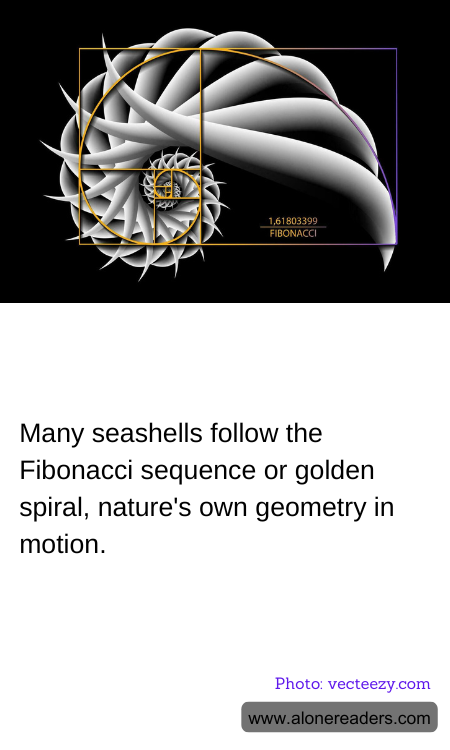
Nature is a master artist, crafting intricate designs that captivate the human eye and inspire awe. Among its most mesmerizing creations are seashells, which often exhibit patterns that follow the Fibonacci sequence or the golden spiral. These mathematical concepts, deeply rooted in nature's geometry, reveal a fascinating intersection between mathematics and the natural world.
The Fibonacci sequence is a series of numbers where each number is the sum of the two preceding ones, starting from 0 and 1. This sequence—0, 1, 1, 2, 3, 5, 8, 13, and so on—appears in various natural phenomena, from the arrangement of leaves on a stem to the branching of trees. In the world of seashells, this sequence manifests itself in the spiral patterns that many shells exhibit. The nautilus shell is a classic example, with its chambers expanding in a logarithmic spiral that mirrors the Fibonacci sequence. This spiral is not just a random occurrence but a result of efficient growth patterns that allow the organism to maintain its shape as it grows.
The golden spiral, closely related to the Fibonacci sequence, is another captivating pattern found in seashells. This spiral is derived from the golden ratio, an irrational number approximately equal to 1.6180339887. When a rectangle with sides in the golden ratio is divided into a square and a smaller rectangle, the smaller rectangle will also have sides in the golden ratio. This process can continue indefinitely, creating a spiral that is both aesthetically pleasing and mathematically significant. Many seashells, such as the chambered nautilus, exhibit this golden spiral, showcasing nature's penchant for harmony and balance.
The presence of these mathematical patterns in seashells is not merely a coincidence but a testament to the efficiency and beauty of nature's design. The Fibonacci sequence and the golden spiral allow for optimal growth and structural integrity, enabling seashells to withstand the pressures of their aquatic environments. These patterns also enhance the shells' aesthetic appeal, drawing the admiration of humans who have long been fascinated by their symmetry and elegance.
Beyond their mathematical significance, seashells serve as a reminder of the interconnectedness of all things. The same principles that govern the growth of a seashell can be found in galaxies, hurricanes, and even the human body. This universal geometry underscores the idea that nature operates according to a set of rules that transcend individual organisms, creating a harmonious and interconnected world.
In conclusion, the Fibonacci sequence and the golden spiral are more than just mathematical curiosities; they are fundamental components of nature's design. Seashells, with their intricate patterns and elegant spirals, offer a glimpse into the profound beauty and complexity of the natural world. As we marvel at these natural wonders, we are reminded of the delicate balance and intricate order that underpin the universe, inviting us to explore and appreciate the hidden mathematics in the world around us.
