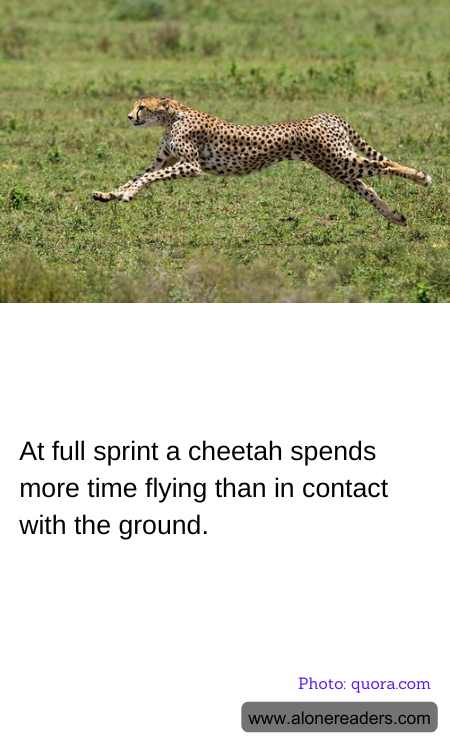
The cheetah, renowned as the fastest land animal, is a marvel of nature's engineering. Capable of reaching speeds up to 70 miles per hour, this extraordinary feline has evolved to become the ultimate sprinter. One of the most fascinating aspects of a cheetah's high-speed chase is the fact that, at full sprint, it spends more time airborne than in contact with the ground. This unique characteristic is a testament to the cheetah's specialized anatomy and its adaptation to life on the African savannah.
When a cheetah accelerates to its top speed, its body undergoes a series of remarkable transformations. The cheetah's spine acts like a spring, flexing and extending with each stride, which allows its legs to reach far forward and backward. This flexibility is crucial for achieving the long strides necessary for high-speed running. During a sprint, a cheetah's stride can measure up to 25 feet, and it can take as many as four strides per second. This rapid, expansive movement is what enables the cheetah to spend more time in the air than on the ground.
The cheetah's lightweight frame and specialized muscles also contribute to its ability to remain airborne for extended periods. Unlike other big cats, the cheetah has a small, aerodynamic head and a slender body, reducing air resistance as it moves. Its powerful hind legs provide the thrust needed to propel it forward, while its long tail acts as a rudder, helping to maintain balance and direction during high-speed pursuits. The combination of these features allows the cheetah to achieve a flight-like state, where its paws touch the ground only briefly before launching into the next stride.
This aerial prowess is not just a spectacle of nature but a critical survival mechanism. The cheetah's ability to remain airborne for longer periods during a sprint gives it a significant advantage when hunting. By minimizing ground contact, the cheetah reduces friction and conserves energy, enabling it to maintain high speeds over short distances. This is essential for catching prey, as the cheetah relies on its speed to close the gap between itself and its target quickly. However, this incredible speed comes at a cost. The cheetah can only sustain such intense exertion for about 20 to 30 seconds before overheating, necessitating a precise and calculated approach to hunting.
In conclusion, the cheetah's ability to spend more time flying than in contact with the ground during a sprint is a remarkable adaptation that underscores its status as the fastest land animal. This unique trait, born from a combination of anatomical and physiological specializations, highlights the cheetah's evolutionary journey and its mastery of speed. As we continue to study and admire these magnificent creatures, we gain a deeper appreciation for the intricate balance of nature and the incredible adaptations that allow life to thrive in diverse environments.
