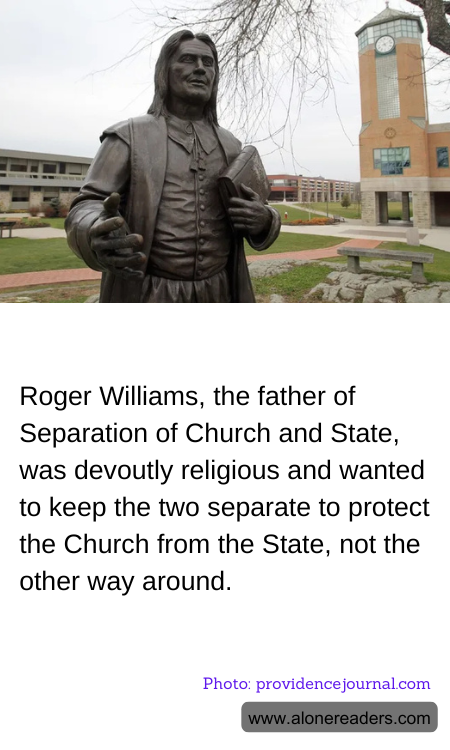
Roger Williams, a pivotal figure in American history, is often celebrated as the father of the principle of separation of church and state. His advocacy for this separation was not born out of a desire to diminish the influence of religion in public life, but rather to protect the sanctity and purity of the church from the corrupting influence of political power. Williams, a devoutly religious man, believed that the church's spiritual mission should remain untainted by the ambitions and machinations of the state.
In the 17th century, when Williams lived, the intertwining of church and state was a common practice in Europe and the American colonies. Many believed that a unified church and state would ensure moral governance. However, Williams saw the dangers inherent in such a union. He argued that when the state wielded power over religious matters, it could lead to the persecution of those with differing beliefs and the imposition of a singular religious doctrine. This, he feared, would stifle true religious expression and corrupt the church's spiritual mission.
Williams' vision was revolutionary for his time. He founded the colony of Rhode Island as a haven for religious freedom, where individuals could worship according to their conscience without fear of state interference. This was a radical departure from the prevailing norms, where dissenters often faced persecution. Williams' commitment to religious liberty was rooted in his belief that faith should be a personal journey, free from governmental coercion. By keeping the church and state separate, he sought to ensure that the church could focus on its spiritual duties, unencumbered by political agendas.
His ideas laid the groundwork for the First Amendment of the United States Constitution, which guarantees religious freedom and prohibits the establishment of a state religion. Williams' legacy is a testament to the importance of protecting religious institutions from the influence of political power. His vision was not to diminish the role of religion in society but to preserve its integrity by ensuring that it remained independent of state control.
In today's world, where debates about the role of religion in public life continue, Williams' insights remain profoundly relevant. His belief in the separation of church and state as a means to protect religious freedom underscores the importance of maintaining boundaries that allow both institutions to thrive independently. Roger Williams' legacy is a reminder that true religious freedom is best preserved when the church and state operate in their distinct spheres, each respecting the other's role in society.
