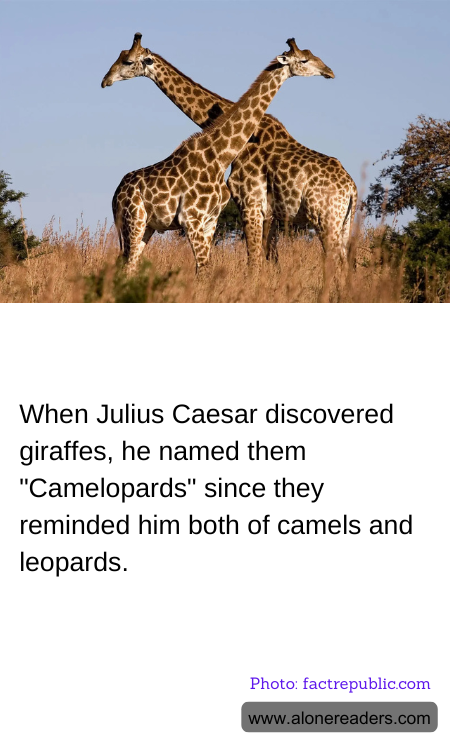
In the annals of history, few figures are as renowned as Julius Caesar, the Roman general and statesman whose influence shaped the course of Western civilization. Among his many accomplishments, one lesser-known yet fascinating anecdote involves his encounter with a peculiar creature that would captivate the imaginations of Romans and Europeans alike: the giraffe. When Julius Caesar first laid eyes on this extraordinary animal, he was so struck by its unique appearance that he coined a new term to describe it—"camelopard."
The name "camelopard" is a testament to the giraffe's distinctive features, which reminded Caesar of both camels and leopards. The giraffe's long neck and towering stature brought to mind the camel, an animal well-known to the Romans for its ability to traverse great distances across arid landscapes. Meanwhile, the giraffe's spotted coat, reminiscent of a leopard's, added an exotic flair that was both intriguing and bewildering to those who had never encountered such a creature before.
Caesar's introduction of the giraffe to Rome was part of a grand spectacle designed to showcase the power and reach of the Roman Empire. During his celebrated triumphs, which were lavish parades held to honor military victories, Caesar displayed the giraffe to the Roman populace. This was not merely an exhibition of an exotic animal but a demonstration of Rome's expanding influence and the wonders that lay beyond its borders. The giraffe, with its graceful gait and striking appearance, became a symbol of the empire's ability to conquer and assimilate the unknown.
The term "camelopard" persisted for centuries, even as the giraffe became more familiar to Europeans through exploration and trade. It wasn't until much later that the name "giraffe," derived from the Arabic word "zarafa," became the standard term for this majestic animal. Yet, the story of the camelopard endures as a reminder of the human tendency to interpret the unfamiliar through the lens of the known, blending elements of the familiar to make sense of the novel.
Today, the giraffe continues to captivate people of all ages with its elegant stature and gentle demeanor. It stands as a testament to the diversity of life on Earth and the enduring curiosity that drives humanity to explore and understand the world around us. Julius Caesar's initial encounter with the giraffe and his imaginative naming of it as the "camelopard" is a charming footnote in history, illustrating the timeless wonder that new discoveries inspire. As we continue to explore our planet and beyond, the spirit of curiosity that led Caesar to marvel at the giraffe remains as vital as ever.
