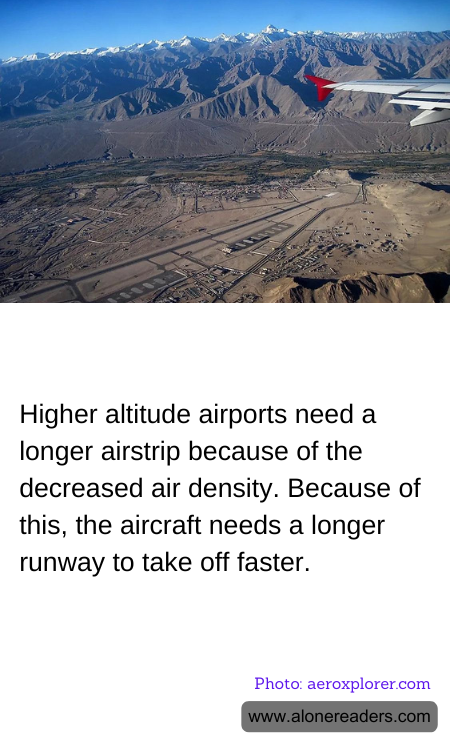
Airports located at higher altitudes face unique challenges due to the decreased air density, which significantly impacts aircraft performance. One of the most critical adaptations required at these airports is the need for longer runways. This necessity arises from the fundamental principles of aerodynamics and the physics of flight, which dictate that aircraft require a certain amount of lift to become airborne. Lift is generated by the flow of air over the wings, and the amount of lift produced is directly related to air density. At higher altitudes, the air is thinner, meaning there are fewer air molecules to generate the necessary lift.
As a result, aircraft need to achieve a higher ground speed to generate the same amount of lift as they would at sea level. This requirement translates into a need for longer runways, as planes must travel a greater distance to reach the necessary takeoff speed. The reduced air density also affects engine performance, as engines rely on a certain amount of air intake to produce thrust. With less air available, engines may produce less power, further necessitating a longer runway to achieve the required takeoff velocity.
The design and construction of runways at high-altitude airports must account for these factors to ensure safety and efficiency. Engineers and planners must carefully calculate the necessary runway length based on the specific altitude of the airport, the types of aircraft that will be using the facility, and the typical weather conditions. In some cases, this can result in runways that are significantly longer than those found at airports closer to sea level.
For pilots, taking off from a high-altitude airport requires careful planning and execution. They must account for the increased takeoff distance in their flight plans and ensure that their aircraft is capable of achieving the necessary speed within the available runway length. This often involves adjusting the aircraft's weight by reducing cargo or fuel load to improve performance.
In conclusion, the need for longer runways at high-altitude airports is a direct consequence of the decreased air density found at these elevations. This adaptation is essential to ensure that aircraft can safely and efficiently take off, despite the challenges posed by the thinner air. By understanding and addressing these unique requirements, high-altitude airports can continue to operate effectively, providing vital connectivity to regions that might otherwise be isolated.
