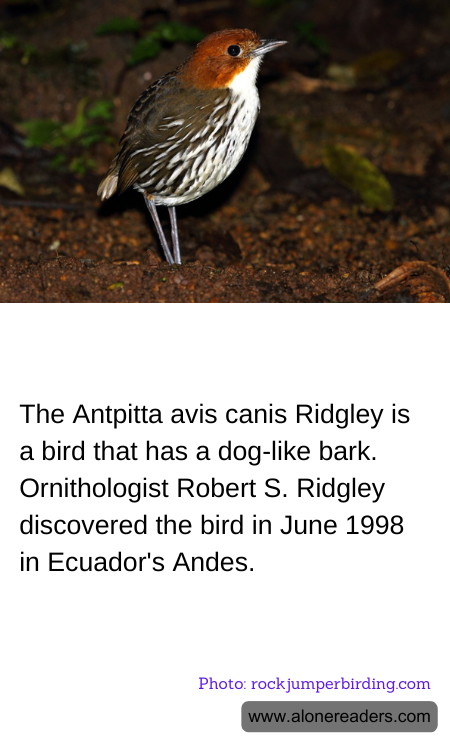
In the lush, verdant landscapes of Ecuador's Andes, a remarkable discovery was made in June 1998 by renowned ornithologist Robert S. Ridgley. This discovery was none other than the Antpitta avis canis Ridgley, a bird that has captivated the interest of bird enthusiasts and scientists alike due to its unique vocalization—a dog-like bark.
The Antpitta avis canis Ridgley is a fascinating species that stands out not only for its unusual call but also for its elusive nature. Nestled within the dense undergrowth of the Andean cloud forests, this bird is notoriously difficult to spot. Its plumage, a blend of earthy tones, provides excellent camouflage against the forest floor, making visual sightings rare and treasured among bird watchers. However, it is the bird's distinctive bark that often gives away its presence, echoing through the forest and piquing the curiosity of those who hear it.
Robert S. Ridgley's discovery of this bird added a new layer to the rich tapestry of avian biodiversity in the Andes. The region is already celebrated for its incredible variety of bird species, many of which are endemic to the area. The Antpitta avis canis Ridgley contributes to this diversity, offering insights into the evolutionary adaptations that have allowed it to thrive in such a specific ecological niche. Its dog-like bark is believed to be an evolutionary trait that may serve various purposes, from communication with other birds to deterring potential predators.
The discovery of the Antpitta avis canis Ridgley underscores the importance of conservation efforts in the Andes. As human activities continue to encroach upon these pristine habitats, the need to protect such unique species becomes ever more critical. Conservationists emphasize the significance of preserving the cloud forests not only for the Antpitta but for the myriad of other species that call this region home. Efforts to maintain these habitats are vital to ensuring that future generations can experience the wonder of hearing the Antpitta's bark echo through the Andes.
For those fortunate enough to encounter the Antpitta avis canis Ridgley, the experience is often described as magical. The bird's presence serves as a reminder of the mysteries that still lie hidden within the world's forests, waiting to be discovered. As scientists continue to study this enigmatic bird, it stands as a symbol of the wonders of nature and the endless possibilities that await in the realm of ornithology.
In conclusion, the Antpitta avis canis Ridgley is more than just a bird with a peculiar call; it is a testament to the rich biodiversity of the Andes and the ongoing need for conservation. Its discovery by Robert S. Ridgley has not only enriched our understanding of avian life but also highlighted the delicate balance of ecosystems that must be preserved. As we continue to explore and learn from the natural world, the Antpitta remains a beacon of curiosity and a call to action for preserving the planet's precious wildlife.
