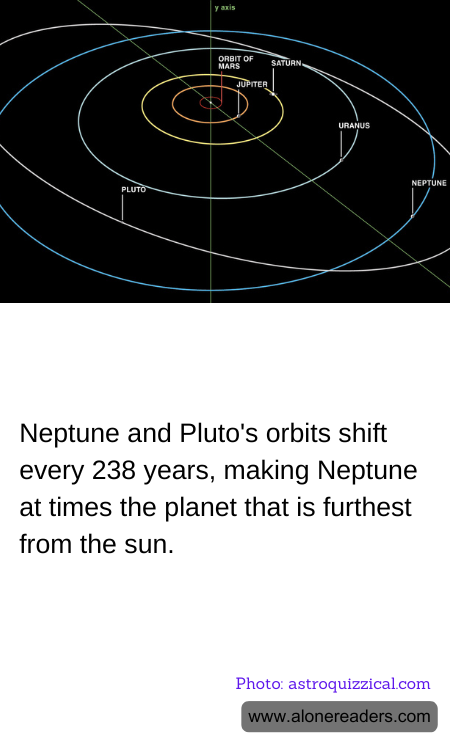
In the vast expanse of our solar system, the celestial dance between Neptune and Pluto offers a fascinating glimpse into the dynamic nature of planetary orbits. While Pluto was once considered the ninth planet, its reclassification as a dwarf planet in 2006 did not diminish the intrigue surrounding its relationship with Neptune. One of the most captivating aspects of this relationship is the orbital shift that occurs every 238 years, during which Neptune occasionally becomes the furthest planet from the Sun.
This orbital phenomenon is a result of the unique paths that Neptune and Pluto take around the Sun. Neptune, the eighth planet, follows a nearly circular orbit, while Pluto's path is more eccentric and inclined. This means that Pluto's orbit is elongated and tilted compared to the relatively flat plane of the solar system. As a result, there are periods when Pluto's orbit takes it closer to the Sun than Neptune, despite being, on average, further away.
The gravitational interactions between Neptune and Pluto play a crucial role in this orbital dance. These interactions ensure that the two bodies never collide, despite their overlapping paths. This is due to a phenomenon known as orbital resonance, where Neptune completes three orbits around the Sun for every two orbits completed by Pluto. This resonance keeps their paths synchronized and prevents any close encounters.
Every 238 years, this orbital resonance results in a temporary shift where Neptune becomes the furthest planet from the Sun. This shift is not only a testament to the intricate gravitational ballet of our solar system but also highlights the ever-changing nature of celestial mechanics. During these periods, Pluto's eccentric orbit brings it closer to the Sun than Neptune, altering the traditional order of the planets.
The study of Neptune and Pluto's orbits provides valuable insights into the complexities of planetary motion and the forces that govern our solar system. It reminds us that the cosmos is not static but a dynamic and ever-evolving tapestry. For astronomers and space enthusiasts alike, these orbital shifts offer a captivating subject of study, illustrating the delicate balance of gravitational forces at play.
In a broader sense, the shifting orbits of Neptune and Pluto serve as a reminder of the wonders of the universe and the mysteries that continue to unfold. As we gaze up at the night sky, we are reminded that there is still much to learn about the celestial bodies that share our cosmic neighborhood. Whether viewed through a telescope or imagined in the mind's eye, the dance of Neptune and Pluto is a testament to the beauty and complexity of the universe we inhabit.
