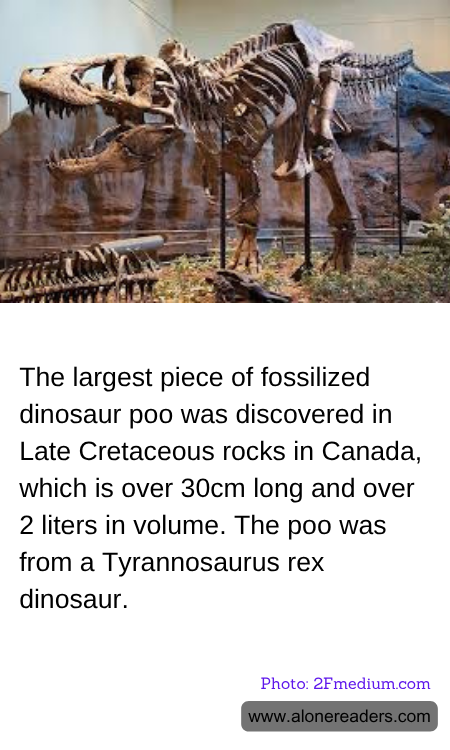
In the fascinating world of paleontology, discoveries often come in unexpected forms, and one such remarkable find is the largest piece of fossilized dinosaur excrement, known as coprolite, unearthed in the Late Cretaceous rocks of Canada. This extraordinary specimen, measuring over 30 centimeters in length and boasting a volume exceeding 2 liters, provides a unique glimpse into the life of one of the most formidable predators to have ever walked the Earth—the Tyrannosaurus rex.
The discovery of this colossal coprolite is not just a curiosity but a significant scientific treasure. It offers a rare opportunity to peek into the dietary habits and ecological role of the T. rex, a creature that has captured the imagination of scientists and the public alike. By analyzing the contents of this ancient dung, researchers can gather invaluable information about the diet of the T. rex, which primarily consisted of large herbivorous dinosaurs. The presence of bone fragments within the coprolite confirms the T. rex's role as a top predator, capable of consuming large prey and digesting bones, a testament to its powerful digestive system.
Beyond its dietary implications, this fossilized feces also provides insights into the environment of the Late Cretaceous period. The preservation of such a specimen suggests that the conditions were just right for fossilization, with rapid burial and mineralization processes that allowed the coprolite to endure for millions of years. This discovery adds to our understanding of the ecosystems that existed during the time of the dinosaurs, offering clues about the climate, vegetation, and other species that coexisted with the T. rex.
The sheer size of this coprolite is a reminder of the immense scale of the creatures that once roamed our planet. It serves as a tangible connection to a distant past, sparking curiosity and wonder about the natural history of Earth. For scientists, it is a puzzle piece that helps reconstruct the life and times of the T. rex, while for the general public, it is a fascinating artifact that brings the prehistoric world to life.
In conclusion, the discovery of the largest piece of fossilized dinosaur poo is more than just an amusing anecdote; it is a window into the ancient world of the T. rex. As researchers continue to study this remarkable find, it promises to yield further insights into the biology and ecology of one of history's most iconic dinosaurs, enriching our understanding of the natural history of our planet.
