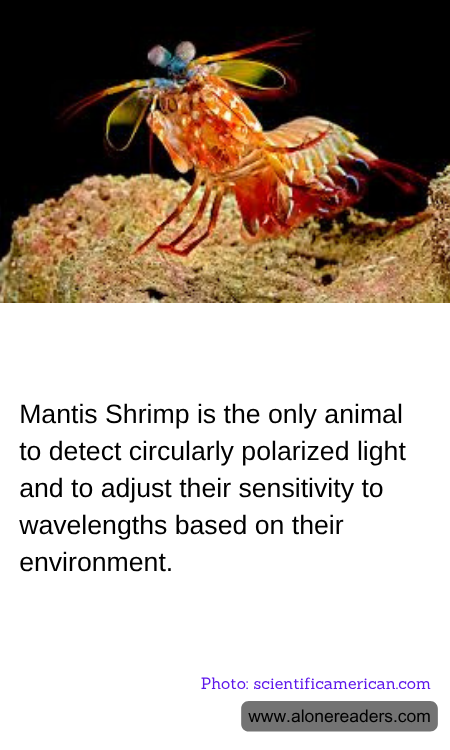
In the vibrant and diverse world of marine life, the mantis shrimp stands out not only for its striking appearance and formidable hunting skills but also for its extraordinary vision. This fascinating crustacean, often found in tropical and subtropical waters, possesses a unique ability that sets it apart from all other known animals: the capacity to detect circularly polarized light. This remarkable visual capability is coupled with the mantis shrimp's ability to adjust its sensitivity to different wavelengths based on its environment, making it a subject of great interest for scientists and nature enthusiasts alike.
Circularly polarized light is a type of light wave that spirals as it travels, a phenomenon not visible to the human eye. While humans and most animals can perceive linear polarization, the mantis shrimp's eyes are equipped with specialized photoreceptors that allow it to detect this more complex form of light. This ability is not just a curious quirk of nature but serves a practical purpose in the mantis shrimp's underwater habitat. By detecting circularly polarized light, these creatures can better navigate their surroundings, communicate with one another, and even spot prey or predators that might otherwise remain hidden.
The mantis shrimp's eyes are a marvel of biological engineering. Each eye operates independently and contains up to 16 different types of photoreceptors, compared to the three found in human eyes. This complex visual system enables the mantis shrimp to perceive a spectrum of colors far beyond human capability, including ultraviolet light. Moreover, the mantis shrimp can dynamically adjust its visual sensitivity to different wavelengths, allowing it to adapt to varying light conditions in its environment. This adaptability is crucial for survival in the diverse lighting conditions of coral reefs, where light can change rapidly due to water depth, turbidity, and the shifting position of the sun.
The study of the mantis shrimp's vision has implications beyond understanding marine biology. Researchers are exploring how this unique ability can inspire new technologies, such as advanced optical devices and improved imaging systems. By mimicking the mantis shrimp's visual system, scientists hope to develop cameras and sensors that can detect polarized light, which could have applications in fields ranging from medical imaging to underwater exploration.
In summary, the mantis shrimp is a testament to the wonders of evolution, showcasing an extraordinary adaptation that allows it to thrive in its underwater world. Its ability to detect circularly polarized light and adjust to different wavelengths is not only a fascinating aspect of its biology but also a potential source of inspiration for technological innovation. As we continue to explore and understand the natural world, the mantis shrimp reminds us of the incredible diversity and complexity of life on Earth.
