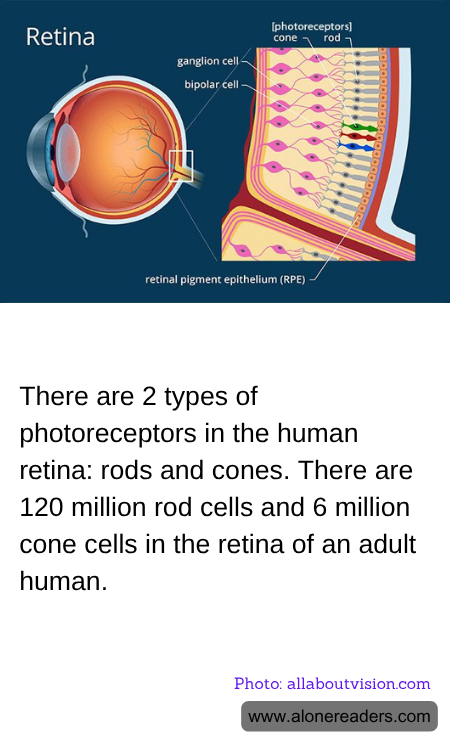
The human eye is a marvel of biological engineering, capable of perceiving a vast array of colors and adapting to various lighting conditions. At the heart of this capability are two types of photoreceptors located in the retina: rods and cones. These specialized cells play a crucial role in how we see the world around us.
Rods are the more numerous of the two, with approximately 120 million rod cells present in the retina of an adult human. They are highly sensitive to light, making them essential for vision in low-light conditions. Rods do not detect color; instead, they are responsible for our ability to see in shades of gray when lighting is dim. This is why, in a dark room or under the night sky, our vision is primarily in black and white. Rods are distributed throughout the retina but are absent from the fovea, the small central pit in the retina responsible for sharp central vision.
In contrast, cone cells number around 6 million in the human retina and are concentrated in the fovea. Cones are responsible for our ability to perceive color and fine detail. There are three types of cone cells, each sensitive to different wavelengths of light corresponding to the colors red, green, and blue. The brain combines the input from these cones to produce the full spectrum of colors we experience. Unlike rods, cones require brighter light to function effectively, which is why colors appear more vivid in well-lit conditions.
The interplay between rods and cones allows humans to have a versatile visual system. During the day, when light is abundant, cones dominate our vision, providing clarity and color. At night or in dim environments, rods take over, allowing us to navigate and recognize shapes and movements even when colors fade into the background. This dual system ensures that we can adapt to a wide range of lighting conditions, from the bright midday sun to the subtle glow of moonlight.
Understanding the functions of rods and cones not only highlights the complexity of the human eye but also underscores the importance of protecting our vision. Factors such as prolonged exposure to bright light, poor nutrition, and aging can affect the health of these photoreceptors. Maintaining a diet rich in vitamins A, C, and E, along with regular eye check-ups, can help preserve the delicate balance between rods and cones, ensuring that our vision remains sharp and vibrant throughout our lives.
In summary, the human retina's rods and cones work in harmony to provide a comprehensive visual experience. While rods excel in low-light conditions, cones bring the world to life with color and detail. Together, they form a sophisticated system that allows us to perceive and interact with our environment in all its complexity.
