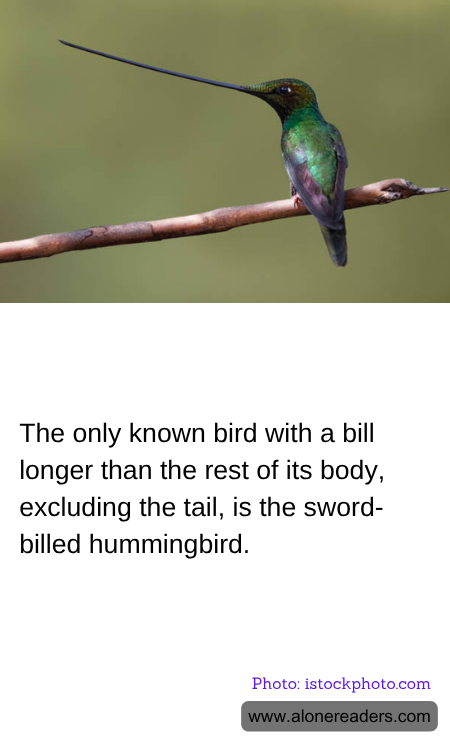
In the vibrant tapestry of the avian world, few creatures capture the imagination quite like the sword-billed hummingbird. This remarkable bird, native to the Andean regions of South America, stands out not only for its dazzling plumage but also for its extraordinary bill. The sword-billed hummingbird is the only known bird species whose bill is longer than the rest of its body, excluding the tail. This unique adaptation is not just a marvel of nature but also a testament to the intricate evolutionary dance between flora and fauna.
The sword-billed hummingbird's bill can reach up to 10 centimeters in length, which is longer than its body, excluding the tail. This remarkable feature allows the bird to access nectar from flowers with long corollas, such as the passionflower. These flowers have evolved to accommodate the bird's lengthy bill, creating a symbiotic relationship that benefits both the plant and the bird. As the hummingbird feeds, it inadvertently transfers pollen from one flower to another, playing a crucial role in the plant's reproductive process.
Despite its seemingly cumbersome bill, the sword-billed hummingbird is an agile and efficient flyer. Its long bill is perfectly balanced by its lightweight body and rapid wing beats, allowing it to hover effortlessly as it feeds. This ability to hover is essential, as it enables the bird to access nectar from flowers that hang in mid-air or grow on steep slopes. The hummingbird's long bill also serves as a deterrent to predators, as it can be used to ward off threats with swift, precise jabs.
The sword-billed hummingbird's diet is not limited to nectar alone. Like other hummingbirds, it supplements its diet with small insects and spiders, which provide essential proteins and nutrients. The bird's long bill is adept at snatching prey from the air or plucking it from foliage, showcasing its versatility as a forager.
Conservation efforts are crucial for the sword-billed hummingbird, as its habitat in the Andean cloud forests is increasingly threatened by deforestation and climate change. Protecting these delicate ecosystems ensures the survival of this unique species and the myriad other creatures that share its habitat. By preserving the natural environment, we safeguard the intricate web of life that supports not only the sword-billed hummingbird but countless other species as well.
In conclusion, the sword-billed hummingbird is a fascinating example of nature's ingenuity. Its extraordinary bill is a testament to the complex interplay between species and their environments, highlighting the importance of biodiversity and conservation. As we continue to explore and understand the natural world, the sword-billed hummingbird serves as a reminder of the wonders that await discovery and the delicate balance that sustains life on our planet.
