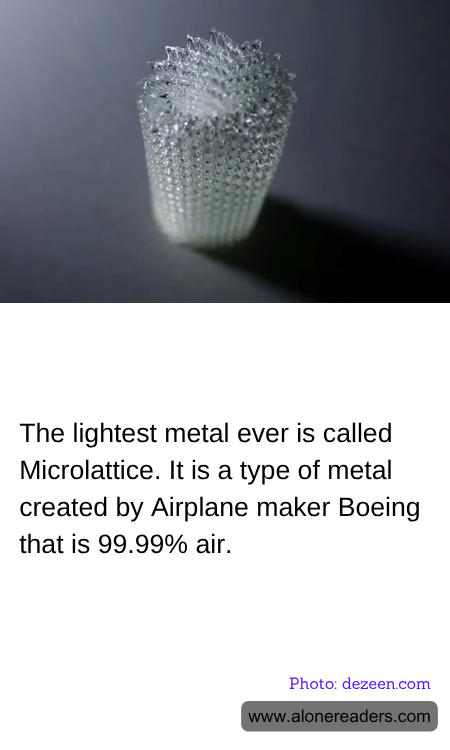
In the ever-evolving world of materials science, a groundbreaking innovation has emerged that could revolutionize industries ranging from aerospace to automotive. This innovation is known as Microlattice, a remarkable material developed by Boeing that stands as the lightest metal ever created. Composed of 99.99% air, Microlattice is a marvel of engineering that combines the strength of metal with the weightlessness of a feather.
Microlattice's unique structure is inspired by the intricate design of human bones, which are both lightweight and incredibly strong. This metal is constructed using a lattice of interconnected hollow tubes, each with a wall thickness of just 100 nanometers—1,000 times thinner than a human hair. This design allows Microlattice to maintain its shape and strength while being extraordinarily light. The material's open-cellular architecture is what makes it so unique, allowing it to compress and absorb energy efficiently, much like a shock absorber.
The potential applications for Microlattice are vast and varied. In the aerospace industry, where every ounce of weight saved can lead to significant fuel savings, Microlattice could be used to create lighter aircraft components, reducing overall weight and improving fuel efficiency. This could lead to more environmentally friendly air travel, with reduced carbon emissions and lower operational costs. Similarly, in the automotive industry, Microlattice could be used to manufacture lighter vehicles, enhancing fuel efficiency and performance while maintaining safety standards.
Beyond transportation, Microlattice's unique properties make it suitable for a range of other applications. Its energy absorption capabilities could be utilized in protective gear, such as helmets and body armor, providing enhanced protection without adding extra weight. Additionally, its lightweight nature makes it an ideal candidate for use in portable electronic devices, potentially leading to longer battery life and more efficient energy usage.
The development of Microlattice is a testament to the power of innovation and the potential of materials science to transform industries and improve everyday life. As researchers continue to explore and refine this remarkable material, the possibilities for its application are virtually limitless. With its combination of strength, lightness, and versatility, Microlattice represents a significant step forward in the quest for more efficient and sustainable materials.
In conclusion, Microlattice is not just a scientific curiosity but a practical solution to some of the most pressing challenges faced by modern industries. Its creation marks a significant milestone in the ongoing pursuit of materials that can do more with less, paving the way for a future where efficiency and sustainability go hand in hand. As we look to the future, the impact of Microlattice is likely to be felt across a wide range of sectors, heralding a new era of innovation and possibility.
