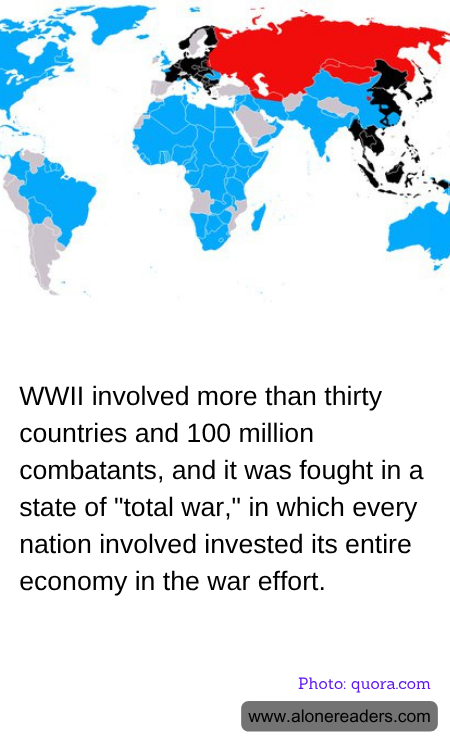
World War II, a global conflict that raged from 1939 to 1945, was one of the most significant and devastating events in human history. It involved more than thirty countries and engaged over 100 million combatants from across the globe. The war was characterized by a state of "total war," a concept that meant every nation involved committed its entire economy and resources to the war effort, blurring the lines between military and civilian sectors.
The scale of World War II was unprecedented. Nations mobilized their entire populations and economies to support the war effort, leading to innovations in technology and industry that would change the world forever. Factories that once produced consumer goods were rapidly converted to manufacture weapons, vehicles, and other military supplies. In the United States, for example, the automotive industry shifted from making cars to producing tanks and aircraft, while in the Soviet Union, entire industries were relocated to avoid the advancing German forces.
The war effort also required a massive workforce, leading to significant social changes. With millions of men serving in the military, women entered the workforce in unprecedented numbers, taking on roles that were previously considered unsuitable for them. This shift not only contributed to the war effort but also laid the groundwork for future social changes regarding gender roles and equality.
The concept of total war also meant that civilian populations were directly affected by the conflict. Cities were targeted in bombing campaigns, leading to significant civilian casualties and destruction. The Blitz in London and the firebombing of Dresden are stark examples of how the war reached into the lives of ordinary people, causing widespread suffering and hardship.
Economically, the war led to the development of new financial systems and practices. Governments took control of industries, rationed goods, and implemented price controls to manage the war economy. The need for resources led to innovations in logistics and supply chain management, which would have lasting impacts on global trade and economic practices.
The end of World War II saw the emergence of the United States and the Soviet Union as superpowers, setting the stage for the Cold War. The war also led to the establishment of the United Nations, an international organization aimed at preventing future conflicts on such a devastating scale. The lessons learned from the total war effort of World War II continue to influence military strategy, economic policy, and international relations to this day.
In conclusion, World War II was not just a military conflict but a total war that reshaped nations and societies. The commitment of entire economies and populations to the war effort demonstrated the profound impact that such a conflict can have on the world. The legacy of World War II is a testament to the resilience and adaptability of nations in the face of unprecedented challenges, and its lessons remain relevant as we navigate the complexities of the modern world.
