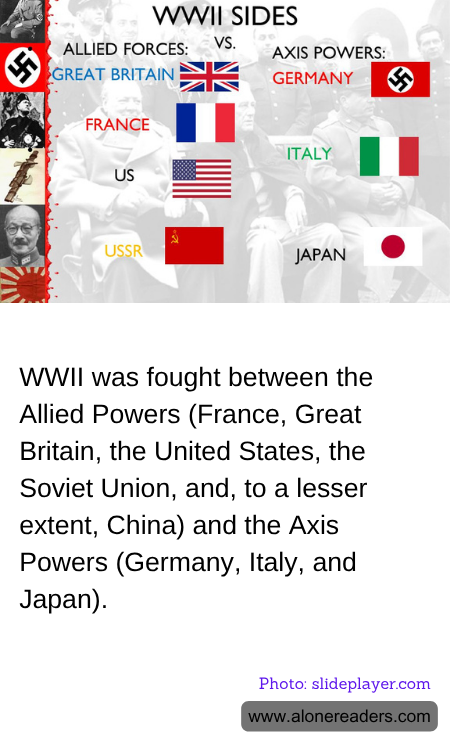
World War II, a global conflict that lasted from 1939 to 1945, was one of the most significant and devastating wars in human history. It was primarily fought between two major alliances: the Allied Powers and the Axis Powers. The Allies consisted of France, Great Britain, the United States, the Soviet Union, and, to a lesser extent, China. Meanwhile, the Axis Powers were led by Germany, Italy, and Japan. This war reshaped the global order and had profound impacts on the political, social, and economic landscapes of the world.
The origins of World War II can be traced back to the unresolved issues of World War I and the Treaty of Versailles, which left Germany economically crippled and politically unstable. Adolf Hitler's rise to power in Germany, with his aggressive expansionist policies, set the stage for conflict. Germany's invasion of Poland in September 1939 prompted Britain and France to declare war, marking the official start of World War II. Italy, under Benito Mussolini, and Japan, with its imperial ambitions in Asia, soon joined Germany, forming the Axis Powers.
The Allied Powers, initially led by France and Great Britain, were later joined by the United States following the Japanese attack on Pearl Harbor in December 1941. The Soviet Union, initially neutral due to a non-aggression pact with Germany, joined the Allies after being invaded by Germany in 1941. China, already engaged in a prolonged conflict with Japan, also aligned with the Allies. This diverse coalition brought together nations with different ideologies and goals, united by the common objective of defeating the Axis Powers.
The war was fought on multiple fronts, with significant battles occurring in Europe, North Africa, and the Pacific. The Allies' strategy involved coordinated military campaigns to weaken the Axis Powers. In Europe, the D-Day invasion of Normandy in June 1944 marked a turning point, leading to the liberation of Western Europe from Nazi occupation. In the Pacific, the United States employed island-hopping tactics to gradually reclaim territories occupied by Japan, culminating in the dropping of atomic bombs on Hiroshima and Nagasaki in August 1945.
The defeat of the Axis Powers was achieved through a combination of military might, strategic alliances, and the resilience of the Allied nations. The war officially ended with the unconditional surrender of Germany in May 1945 and Japan in September 1945. The aftermath of World War II saw the emergence of the United States and the Soviet Union as superpowers, setting the stage for the Cold War. The war also led to the establishment of the United Nations, aimed at preventing future global conflicts and promoting international cooperation.
World War II remains a pivotal chapter in history, teaching valuable lessons about the dangers of totalitarianism, the importance of international collaboration, and the enduring human spirit in the face of adversity. Its legacy continues to influence global politics and serves as a reminder of the need for peace and understanding among nations.
