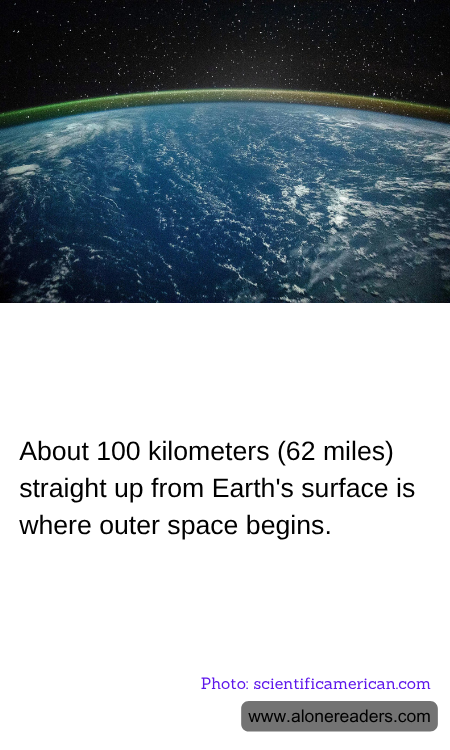
Outer space, a realm of mystery and wonder, begins at a point known as the Kármán line, situated approximately 100 kilometers (62 miles) above Earth's surface. This boundary, named after Hungarian-American engineer and physicist Theodore von Kármán, marks the transition from our planet's atmosphere to the vast expanse of space. While this demarcation is largely symbolic, it serves as a useful reference for scientists, engineers, and space enthusiasts alike.
The Kármán line is not just an arbitrary boundary; it represents a point where the atmosphere becomes too thin to support conventional aircraft flight. At this altitude, the air density is so low that aerodynamic lift, which allows airplanes to fly, becomes ineffective. Instead, vehicles must rely on orbital velocity to stay aloft, a principle that governs the movement of satellites and spacecraft. This transition highlights the unique challenges and opportunities presented by space exploration.
Reaching the Kármán line is a significant milestone for any space mission. It is the threshold that separates Earth-bound activities from the vastness of space, where gravity's pull is weaker and the environment is starkly different. Beyond this line, the sky turns from blue to black, and the curvature of the Earth becomes visible, offering a breathtaking view that has inspired astronauts and cosmonauts for decades.
The concept of the Kármán line also underscores the incredible achievements of human ingenuity. From the early days of rocketry to the modern era of reusable spacecraft, reaching and surpassing this boundary has been a testament to our relentless pursuit of knowledge and exploration. It is a reminder of how far we have come in our quest to understand the universe and our place within it.
For the general public, the idea of space beginning just 100 kilometers above us is both fascinating and humbling. It puts into perspective the thin veil of atmosphere that protects and sustains life on Earth. This realization fosters a deeper appreciation for our planet and the delicate balance that allows life to thrive.
In conclusion, the Kármán line is more than just a scientific boundary; it is a symbol of human curiosity and the spirit of exploration. It represents the edge of our known world and the beginning of the unknown, inviting us to look up and wonder about the possibilities that lie beyond. As we continue to push the boundaries of space exploration, the Kármán line will remain a pivotal point of reference, guiding us on our journey into the cosmos.
