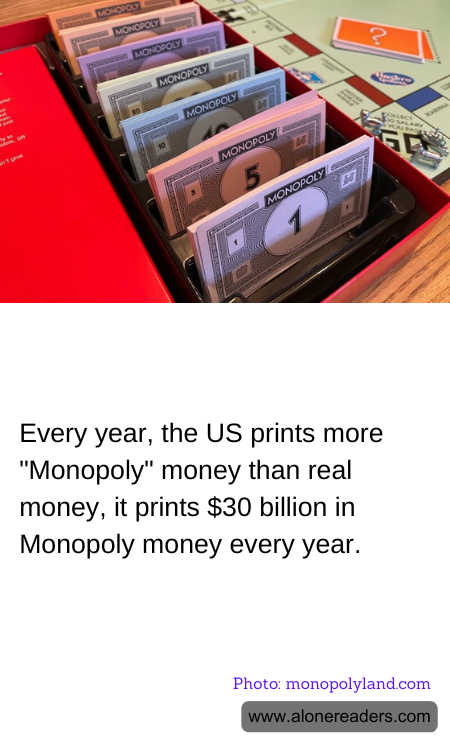
In the world of board games, few names are as iconic as Monopoly. This classic game, which has been a staple in households since its introduction in the early 20th century, is known for its colorful currency that players use to buy properties, build houses, and ultimately bankrupt their opponents. Interestingly, the amount of Monopoly money printed each year surpasses the amount of real currency produced by the United States Treasury. Annually, approximately $30 billion in Monopoly money is printed, a figure that dwarfs the production of actual U.S. currency.
The sheer volume of Monopoly money printed each year is a testament to the game's enduring popularity. Monopoly has been translated into 47 languages and sold in 114 countries, making it a global phenomenon. The game’s appeal lies in its ability to bring people together, offering a mix of strategy, luck, and negotiation. Families and friends gather around the board, engaging in friendly competition that can last for hours. This widespread appeal necessitates the production of vast amounts of Monopoly money to meet the demand for new and replacement game sets.
In contrast, the production of real U.S. currency is a more complex and regulated process. The U.S. Bureau of Engraving and Printing is responsible for producing the nation's paper money, which involves intricate designs and security features to prevent counterfeiting. While the exact amount of real money printed each year varies based on economic needs, it typically falls short of the $30 billion in Monopoly money. This discrepancy highlights the unique nature of Monopoly as a cultural artifact that transcends its role as a simple board game.
The comparison between Monopoly money and real currency also serves as a fascinating reflection on the nature of value and economics. In the game, money is merely a tool for entertainment, with no real-world value beyond the context of the board. However, it teaches players about financial concepts such as budgeting, investment, and risk management. These lessons, learned in the playful context of Monopoly, can have real-world applications, helping players understand the complexities of economics and personal finance.
Moreover, the fact that more Monopoly money is printed than real money each year underscores the importance of play and imagination in our lives. Games like Monopoly offer a respite from the pressures of daily life, allowing players to explore different roles and scenarios in a safe and controlled environment. This aspect of play is crucial for both children and adults, fostering creativity, problem-solving skills, and social interaction.
In conclusion, the annual production of $30 billion in Monopoly money is a fascinating statistic that speaks to the game's global reach and cultural significance. While it may seem surprising that more Monopoly money is printed than real currency, it highlights the enduring appeal of this beloved board game and its role in teaching valuable life skills. As long as families and friends continue to gather around the Monopoly board, the demand for its colorful currency will remain strong, ensuring its place in the annals of gaming history.
