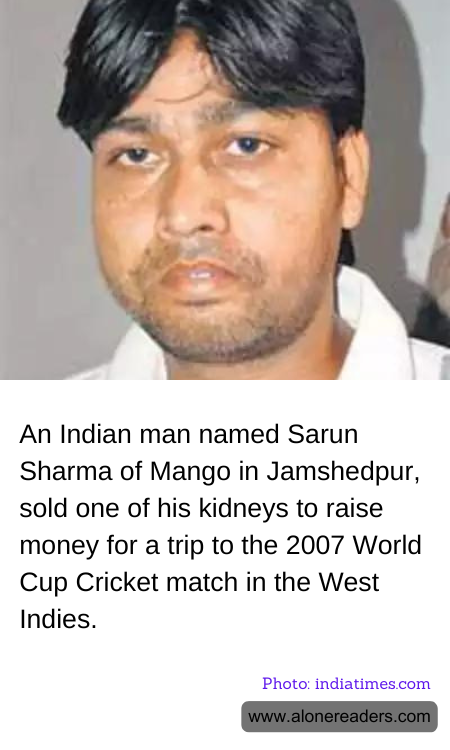
In a tale that underscores the lengths to which some individuals will go to fulfill their dreams, Sarun Sharma, a resident of Mango in Jamshedpur, India, made headlines in 2007 for his extraordinary decision to sell one of his kidneys. His motivation was not driven by financial desperation or medical necessity, but by an unwavering passion for cricket and a once-in-a-lifetime opportunity to witness the World Cup Cricket match in the West Indies.
Cricket, often regarded as a religion in India, has a fervent following, and for many fans, attending a World Cup match is a dream akin to a pilgrimage. For Sarun, the allure of watching his national team compete on the world stage was irresistible. However, the financial constraints of his situation posed a significant barrier. The cost of travel, accommodation, and match tickets was beyond his means, and traditional avenues of funding were not viable options.
Faced with this dilemma, Sarun made the controversial and life-altering decision to sell one of his kidneys. In India, where the black market for organs is a grim reality, Sarun's choice was fraught with risks, both legal and health-related. Yet, his determination to experience the thrill of the World Cup firsthand overshadowed these concerns. The transaction, conducted in secrecy, provided him with the necessary funds to embark on his journey to the Caribbean.
Sarun's story sparked widespread debate and media attention, raising ethical questions about the lengths to which individuals should go to pursue their passions. While some admired his dedication and willingness to sacrifice for his love of cricket, others criticized the decision as reckless and indicative of a society that places undue pressure on individuals to achieve their dreams at any cost.
The incident also highlighted the broader issue of organ trafficking and the desperate measures some people resort to in order to escape poverty or achieve personal goals. It served as a stark reminder of the need for stricter regulations and awareness to prevent exploitation in the organ trade.
Despite the controversy, Sarun's journey to the West Indies was a testament to his unwavering spirit and love for the game. It was a reminder of the powerful hold that sports can have on individuals, transcending boundaries and inspiring acts of both courage and folly. His story remains a poignant example of the complex interplay between passion, desperation, and the human spirit's capacity for sacrifice.
