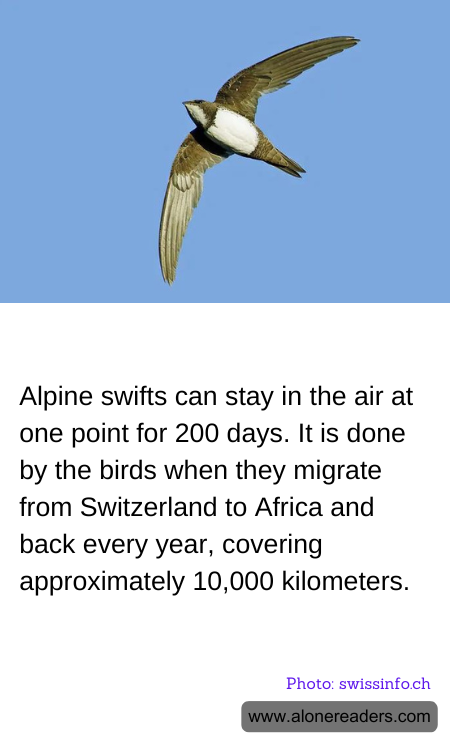
The Alpine swift, a remarkable bird known for its extraordinary aerial endurance, captivates scientists and bird enthusiasts alike with its ability to stay airborne for up to 200 days without landing. This incredible feat occurs during the bird's annual migration from Switzerland to Africa and back, covering an astonishing distance of approximately 10,000 kilometers. The Alpine swift's journey is not only a testament to its physical prowess but also a fascinating example of nature's wonders.
These birds, which belong to the swift family, are specially adapted for life on the wing. Their streamlined bodies, long wings, and forked tails enable them to glide effortlessly through the air, conserving energy during their long flights. The Alpine swift's ability to remain airborne for such extended periods is facilitated by its unique physiological adaptations. While in flight, these birds can rest one hemisphere of their brain at a time, allowing them to sleep while still maintaining control over their flight path. This adaptation is crucial for their survival during the long migratory journey.
The migration of Alpine swifts is a marvel of endurance and navigation. Starting in Switzerland, these birds embark on their southward journey to Africa, where they spend the winter months. Along the way, they traverse diverse landscapes and climates, relying on their keen sense of direction and environmental cues to guide them. The journey is fraught with challenges, including adverse weather conditions and the need to find sufficient food to fuel their long flights. Despite these obstacles, Alpine swifts have evolved to thrive in the skies, feeding on airborne insects and drinking water droplets from clouds.
The ability of Alpine swifts to remain airborne for such extended periods has intrigued scientists, prompting studies to understand the mechanisms behind this phenomenon. Researchers have used lightweight tracking devices to monitor the birds' movements and gather data on their flight patterns. These studies have revealed that Alpine swifts are capable of adjusting their flight altitude and speed in response to weather conditions, optimizing their energy expenditure during migration.
The Alpine swift's remarkable journey is not only a testament to the resilience and adaptability of these birds but also a reminder of the intricate connections within the natural world. Their migration plays a vital role in the ecosystems they traverse, as they help control insect populations and serve as indicators of environmental health. As climate change and habitat loss continue to impact migratory patterns, understanding and protecting these avian travelers becomes increasingly important.
In conclusion, the Alpine swift's ability to stay airborne for 200 days during its migration from Switzerland to Africa is a breathtaking example of nature's ingenuity. These birds, with their exceptional adaptations and endurance, inspire awe and curiosity, highlighting the wonders of the natural world and the importance of preserving it for future generations.
