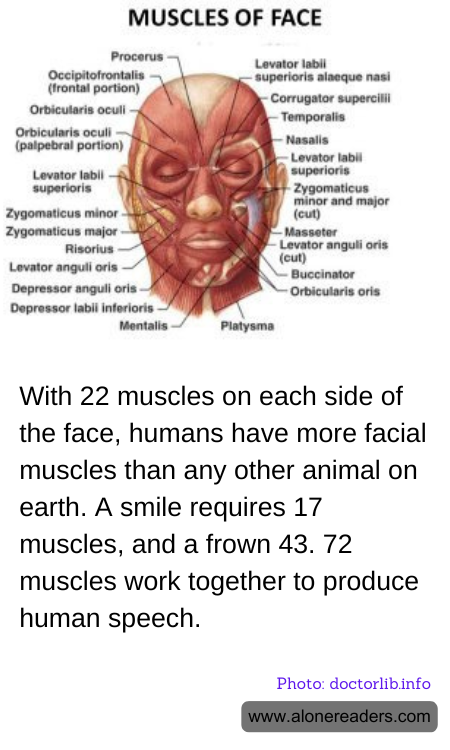
The human face is a marvel of biological engineering, a canvas of expression and communication that sets us apart from other species. With 22 muscles on each side, humans possess more facial muscles than any other animal on Earth. This intricate network of muscles allows us to convey a vast array of emotions and perform complex actions, such as speaking and expressing feelings, which are fundamental to human interaction.
A smile, often considered a universal sign of happiness and friendliness, requires the coordination of 17 muscles. These muscles work in harmony to lift the corners of the mouth and create the familiar expression that can brighten a room and connect people across cultures. The simplicity of a smile belies the complexity of the muscular coordination involved, highlighting the sophistication of human facial anatomy.
In contrast, a frown, which is typically associated with displeasure or sadness, engages 43 muscles. This expression involves a more intricate arrangement of muscle contractions, pulling the eyebrows together and down, and turning the corners of the mouth downward. The greater number of muscles required for a frown compared to a smile has led to the popular saying that it takes more effort to frown than to smile, encouraging people to choose positivity.
Beyond expressions, the human face is also integral to speech, a defining characteristic of our species. An astonishing 72 muscles work together to produce the sounds and words that form the basis of human language. This complex orchestration involves not only the facial muscles but also those in the tongue, lips, and throat. The ability to speak allows us to share ideas, tell stories, and build societies, underscoring the importance of these muscles in our daily lives.
The remarkable capabilities of the human face are a testament to the evolutionary journey that has shaped us. Our facial muscles enable us to express emotions, communicate effectively, and connect with others in ways that are both profound and subtle. Whether through a simple smile or the intricate dance of speech, these muscles play a crucial role in the human experience, making our interactions richer and more meaningful.
In a world where communication is key, the muscles of the human face are unsung heroes, tirelessly working to help us express who we are and how we feel. Their complexity and versatility are a reminder of the incredible potential within each of us to connect, empathize, and understand one another. As we navigate our lives, these muscles silently support us, making every conversation and every expression possible.
