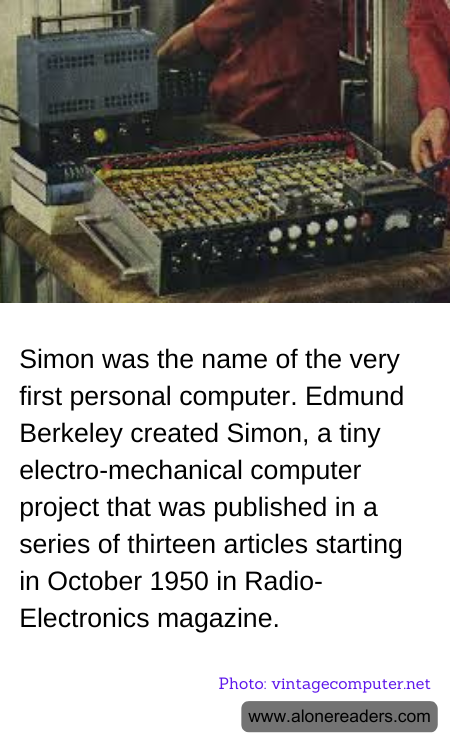
In the annals of computing history, the name "Simon" might not immediately ring a bell for many. However, Simon holds a special place as the very first personal computer, a pioneering creation that laid the groundwork for the technology we often take for granted today. Conceived by Edmund Berkeley, Simon was an electro-mechanical marvel that captured the imagination of tech enthusiasts when it was introduced through a series of articles in Radio-Electronics magazine, beginning in October 1950.
Edmund Berkeley, a visionary in the field of computing, embarked on a mission to make computers accessible to the general public. At a time when computers were massive, room-sized machines operated by specialists, Berkeley's Simon was a radical departure. It was designed to be a small, affordable, and educational device that could be assembled by hobbyists. The project was meticulously documented in a series of thirteen articles, providing step-by-step instructions for building Simon, thus democratizing the knowledge of computing.
Simon was not a computer by today's standards, but it was a significant leap forward in making computing technology more approachable. It was a simple machine, capable of performing basic arithmetic operations and logical functions. The computer was built using relays, a technology that predated the use of transistors and integrated circuits. Despite its simplicity, Simon was a functional computer, demonstrating the principles of computation and serving as an educational tool for those interested in the burgeoning field of computer science.
The impact of Simon extended beyond its technical specifications. It represented a shift in thinking about what computers could be and who could use them. By publishing the project in a widely-read magazine, Berkeley opened the door for a new generation of computer enthusiasts. These hobbyists, inspired by Simon, would go on to become the pioneers of the personal computing revolution that took place decades later.
Simon’s legacy is a testament to the power of imagination and innovation. It showed that computers could be more than just tools for large corporations or government agencies; they could be personal devices, accessible to anyone with the curiosity and determination to understand them. While Simon itself may not have been a commercial success, its influence is undeniable. It inspired a movement that would eventually lead to the development of the personal computers we use today.
In retrospect, Simon was a humble beginning, but it was a crucial step in the evolution of computing. It exemplified the spirit of exploration and education that continues to drive technological advancement. As we look back at the history of personal computing, Simon stands as a reminder of how far we have come and the importance of making technology accessible to all.
