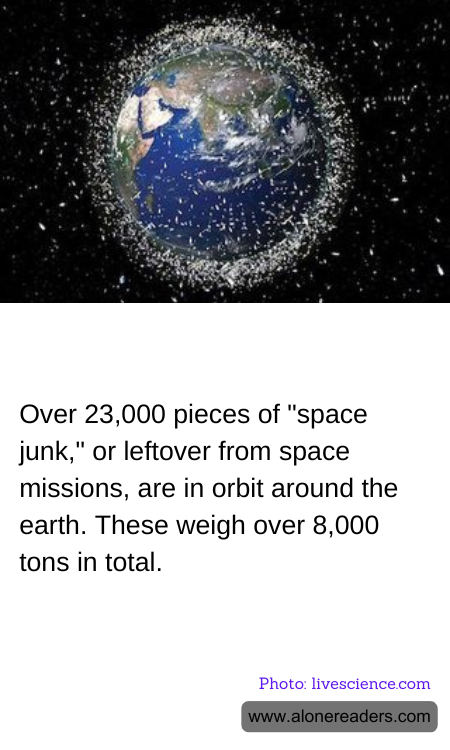
The vast expanse of space surrounding our planet is not as empty as one might imagine. In fact, it is becoming increasingly cluttered with debris, commonly referred to as "space junk." This term encompasses the remnants of defunct satellites, spent rocket stages, and fragments from disintegration, erosion, and collisions. Currently, there are over 23,000 pieces of space junk orbiting Earth, collectively weighing more than 8,000 tons. This growing cloud of debris poses significant challenges and risks to both current and future space missions.
Space junk is a byproduct of humanity's ventures into space, a testament to our technological advancements and exploration efforts. However, as we continue to launch satellites and spacecraft, the remnants of these missions accumulate, creating a hazardous environment. The debris ranges in size from tiny paint flecks to large defunct satellites, all traveling at speeds of up to 28,000 kilometers per hour. At such velocities, even the smallest piece of debris can cause significant damage to operational spacecraft, satellites, and the International Space Station.
The problem of space junk is not just a concern for space agencies and satellite operators; it has broader implications for our daily lives. Many of the technologies we rely on, such as GPS, weather forecasting, and global communications, depend on satellites that are at risk of being damaged by space debris. A collision could lead to a cascade effect, known as the Kessler Syndrome, where the density of objects in low Earth orbit is high enough to cause a chain reaction of collisions, exponentially increasing the amount of debris and potentially rendering certain orbits unusable.
Efforts are underway to mitigate the risks posed by space junk. Space agencies and private companies are developing technologies to track and manage debris, ensuring that new satellites are designed to minimize the creation of additional debris. Innovative solutions, such as using nets, harpoons, or robotic arms to capture and remove debris, are being explored. Additionally, international cooperation and agreements are essential to establish guidelines for responsible behavior in space, including the safe disposal of defunct satellites and the reduction of debris from future missions.
As we look to the future, the challenge of space junk underscores the need for sustainable practices in space exploration. By addressing this issue, we can protect the space environment for future generations, ensuring that space remains a viable frontier for scientific discovery and technological advancement. The task is daunting, but with concerted global efforts, we can tackle the space junk problem and continue to explore the cosmos safely and responsibly.
