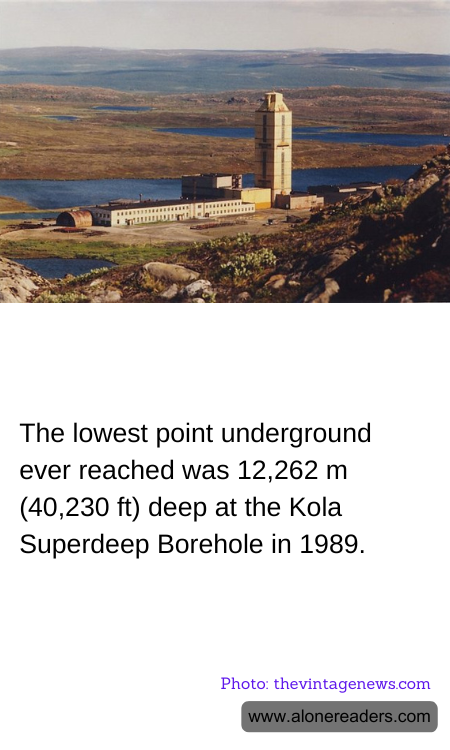
In the remote reaches of the Russian Arctic, a remarkable feat of human engineering and scientific curiosity took place that pushed the boundaries of our understanding of the Earth’s crust. This endeavor, known as the Kola Superdeep Borehole, reached an astounding depth of 12,262 meters (40,230 feet) in 1989, making it the deepest artificial point on Earth. This extraordinary achievement was the result of a Soviet scientific drilling project aimed at exploring the mysteries lying beneath the Earth's surface.
The Kola Superdeep Borehole project began in 1970, driven by a desire to understand the composition and properties of the Earth's crust. Scientists hoped to uncover new insights into geological processes, the nature of the Earth's layers, and the potential for discovering valuable mineral resources. The project was located on the Kola Peninsula, near the Russian border with Norway, where the drilling rig stood as a testament to human perseverance and ambition.
As the drill descended deeper into the Earth, it encountered extreme temperatures and pressures, presenting significant technical challenges. At its deepest point, the temperature reached approximately 180 degrees Celsius (356 degrees Fahrenheit), far hotter than initially anticipated. These conditions tested the limits of drilling technology and required innovative solutions to continue the descent. Despite these challenges, the project persisted, driven by the promise of scientific discovery.
The findings from the Kola Superdeep Borehole were as profound as the depth it reached. Scientists discovered that the Earth's crust was more complex than previously thought, with unexpected variations in rock types and structures. One of the most surprising discoveries was the presence of microscopic fossils at depths where life was not expected to exist, suggesting that life on Earth may have deeper roots than previously believed. Additionally, the project provided valuable data on the geothermal gradient and the behavior of seismic waves, contributing to our understanding of earthquakes and tectonic activity.
While the Kola Superdeep Borehole did not reach the Earth's mantle as initially hoped, its legacy endures as a symbol of human curiosity and the quest for knowledge. The project was eventually halted in 1992 due to funding constraints and the dissolution of the Soviet Union, but the borehole remains a point of fascination for scientists and the public alike. It serves as a reminder of the challenges and rewards of scientific exploration, inspiring future generations to continue probing the depths of our planet.
Today, the Kola Superdeep Borehole stands as a monument to human ingenuity and the relentless pursuit of understanding the natural world. It highlights the importance of scientific exploration in expanding our knowledge and pushing the boundaries of what is possible. As we continue to explore the mysteries of the Earth, the lessons learned from this remarkable project will undoubtedly guide and inspire future endeavors in the quest to unlock the secrets of our planet.
