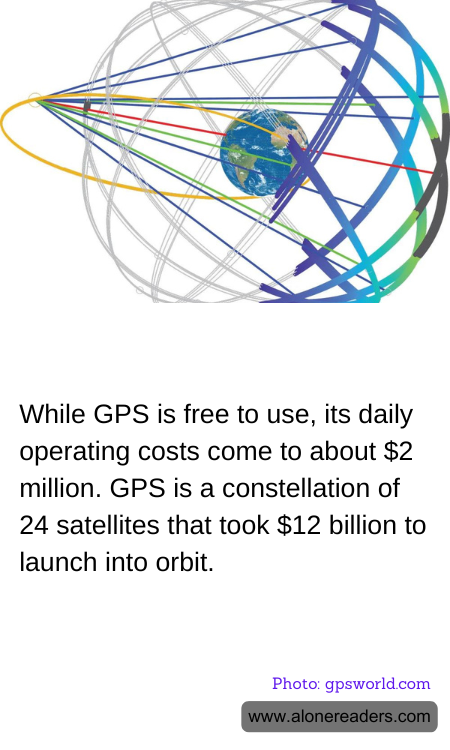
The Global Positioning System, commonly known as GPS, has become an indispensable tool in our daily lives, guiding everything from personal navigation to global logistics. While it is free for users worldwide, the system's operation is far from costless. The daily operating expenses of GPS amount to approximately $2 million, a testament to the complexity and scale of this technological marvel.
GPS is a constellation of 24 satellites orbiting the Earth, a network that was established with a staggering investment of $12 billion. This initial cost covered the launch and deployment of the satellites, which are strategically positioned to ensure that at least four satellites are visible from any point on Earth at any given time. This configuration allows GPS receivers to calculate precise locations by triangulating signals from multiple satellites.
The $2 million daily operating cost is primarily attributed to the maintenance and management of these satellites. This includes monitoring their positions, ensuring they remain in their designated orbits, and updating their onboard atomic clocks, which are crucial for the system's accuracy. Ground control stations around the world play a vital role in this process, continuously communicating with the satellites to ensure they function correctly and provide reliable data.
Despite these significant costs, GPS remains free for public use, a decision rooted in its origins as a U.S. Department of Defense project. Initially developed for military applications, the system was made available for civilian use in the 1980s, revolutionizing navigation and positioning technologies. Today, GPS is integral to various sectors, including transportation, agriculture, emergency services, and even personal fitness.
The decision to keep GPS free for users worldwide reflects its importance as a global utility. It has spurred economic growth and innovation, enabling new technologies and services that rely on precise location data. From ride-sharing apps to precision farming, GPS has transformed how we interact with the world, providing benefits that far outweigh its operational costs.
In conclusion, while the financial commitment to maintaining GPS is substantial, the system's value to society is immeasurable. It exemplifies how investment in technology can yield widespread benefits, enhancing safety, efficiency, and convenience in countless aspects of daily life. As we continue to rely on GPS, it is essential to recognize the intricate infrastructure and ongoing efforts that keep this vital service running smoothly, free of charge for users around the globe.
