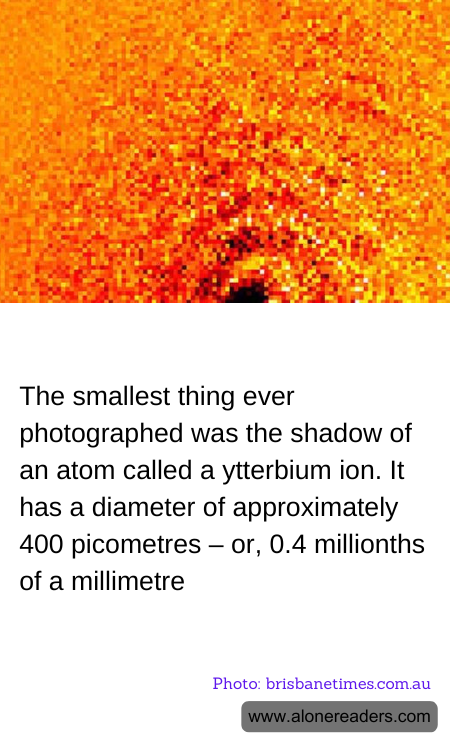
In the realm of scientific discovery, the ability to capture the unseen has always been a driving force behind technological advancement. One of the most remarkable achievements in this field is the photographing of the shadow of an atom, specifically a ytterbium ion. This feat represents a significant milestone in our understanding of the microscopic world, where the boundaries of the visible are continually being pushed.
Atoms, the fundamental building blocks of matter, are incredibly small, with diameters measured in picometres. To put this into perspective, a picometre is one trillionth of a metre. The ytterbium ion, with a diameter of approximately 400 picometres, or 0.4 millionths of a millimetre, is among the smallest entities ever to be photographed. Capturing the shadow of such a minuscule object requires not only advanced technology but also a profound understanding of physics and optics.
The process of photographing an atom's shadow involves intricate techniques that manipulate light at a quantum level. Scientists use a highly focused beam of light to cast a shadow of the atom onto a detector. This shadow is not visible to the naked eye but can be captured using sensitive imaging equipment. The resulting image is a testament to the precision and ingenuity of modern scientific methods.
This achievement is more than just a technical triumph; it has profound implications for various fields of research. By being able to observe and manipulate individual atoms, scientists can gain deeper insights into the fundamental properties of matter. This knowledge is crucial for the development of new materials and technologies, including quantum computing and nanotechnology. The ability to photograph an atom's shadow also opens up new possibilities in the study of atomic interactions and the behavior of matter at the smallest scales.
Moreover, this breakthrough serves as an inspiration for future generations of scientists and engineers. It demonstrates the power of human curiosity and the relentless pursuit of knowledge. As we continue to explore the microscopic universe, each discovery brings us closer to unlocking the mysteries of the natural world.
In conclusion, the photographing of the shadow of a ytterbium ion marks a significant achievement in the field of microscopy and quantum physics. It highlights the incredible advancements in technology that allow us to explore the unseen and understand the fundamental nature of our universe. This accomplishment not only expands our scientific horizons but also fuels the imagination of those who dare to dream of what lies beyond the visible spectrum.
