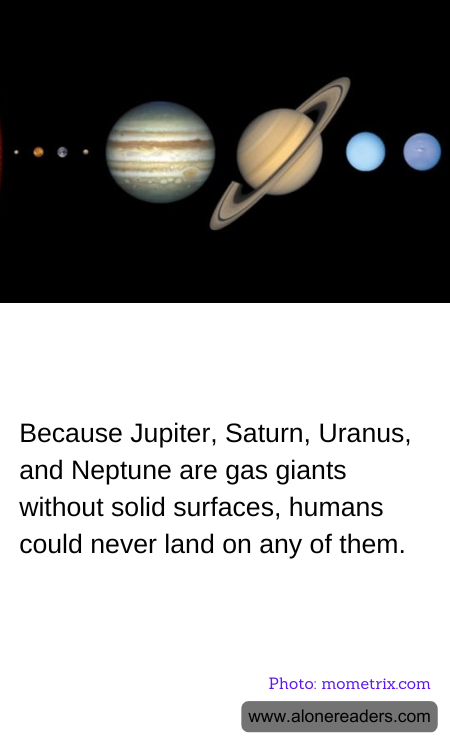
The vastness of our solar system is filled with wonders that continue to captivate our imagination. Among these celestial marvels are the gas giants: Jupiter, Saturn, Uranus, and Neptune. These planets, with their swirling clouds and majestic rings, present a fascinating yet formidable challenge to human exploration. Unlike the rocky planets such as Earth and Mars, these gas giants lack solid surfaces, making the prospect of landing on them an impossibility with our current technology.
Jupiter, the largest planet in our solar system, is a colossal sphere of hydrogen and helium. Its atmosphere is a tempestuous mix of gases, with winds reaching speeds of up to 384 miles per hour. Beneath its thick cloud layers lies a core that is believed to be composed of rock and metal, but this core is surrounded by a vast ocean of liquid metallic hydrogen. The immense pressure and temperature within Jupiter's atmosphere would crush and incinerate any spacecraft long before it could reach the core, rendering a landing mission unfeasible.
Similarly, Saturn, known for its stunning rings, is another gas giant that poses insurmountable challenges for landing. Its atmosphere is primarily hydrogen and helium, with trace amounts of other gases. The lack of a solid surface means that any attempt to land would result in a descent into increasingly dense and hostile atmospheric conditions. The pressure and temperature would rise to levels that no current spacecraft could withstand, making it impossible for humans to set foot on this beautiful planet.
Uranus and Neptune, often referred to as ice giants due to their composition, also present significant obstacles. While they share similarities with Jupiter and Saturn, their atmospheres contain more water, ammonia, and methane, giving them a distinct blue hue. These planets have a small rocky core surrounded by a thick mantle of icy materials. The extreme cold, high pressure, and lack of a solid surface make landing on Uranus or Neptune equally impractical. Any probe attempting to explore these planets would be crushed by the intense atmospheric pressure long before reaching the core.
The gas giants, with their mesmerizing beauty and complex atmospheres, remain out of reach for human landing missions. However, this does not diminish their importance in our quest to understand the universe. Robotic missions, such as the Galileo spacecraft to Jupiter and the Cassini mission to Saturn, have provided invaluable data, enhancing our knowledge of these distant worlds. Future missions may continue to explore these planets from afar, using advanced technology to study their atmospheres, magnetic fields, and moons.
While the dream of landing on a gas giant remains beyond our grasp, the exploration of these planets continues to inspire and challenge us. They remind us of the vastness of the cosmos and the endless possibilities that lie beyond our home planet. As we advance in technology and understanding, who knows what discoveries await us in the swirling clouds of these majestic giants?
