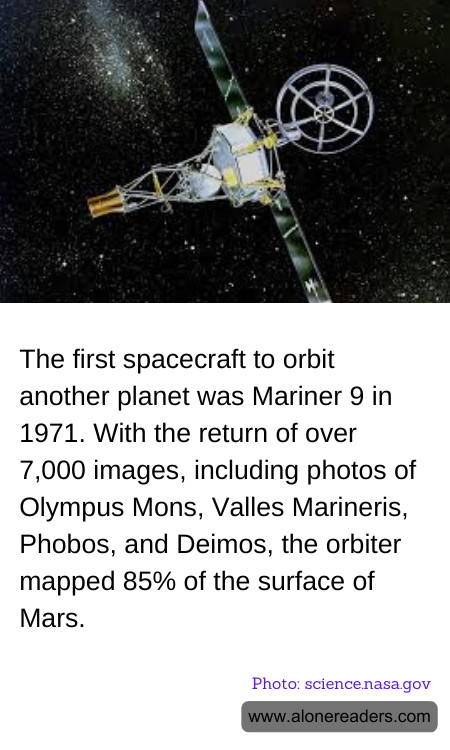
In the annals of space exploration, the year 1971 stands out as a landmark moment when humanity's quest to understand the cosmos took a significant leap forward. This was the year when Mariner 9, a pioneering spacecraft launched by NASA, became the first human-made object to orbit another planet. Its mission was to study Mars, the enigmatic Red Planet that has long captured the imagination of scientists and dreamers alike.
Mariner 9's journey to Mars was not just a technological triumph but a testament to human curiosity and ingenuity. After a six-month voyage through the void of space, the spacecraft entered Martian orbit on November 14, 1971. This achievement marked a new era in planetary exploration, as it allowed for sustained observation and study of Mars from a stable vantage point. Unlike its predecessors, which had only flown by the planet, Mariner 9 was able to conduct a comprehensive survey of the Martian surface.
The mission's success was underscored by the wealth of data it returned to Earth. Over the course of its operation, Mariner 9 sent back more than 7,000 images, providing an unprecedented view of Mars. These images revealed a world that was both familiar and alien, with features that hinted at a complex geological history. Among the most striking discoveries were detailed photographs of Olympus Mons, the tallest volcano in the solar system, and Valles Marineris, a vast canyon system that dwarfs the Grand Canyon on Earth. These features suggested that Mars had been shaped by volcanic activity and tectonic forces, much like our own planet.
In addition to these geological wonders, Mariner 9 also captured images of Mars' two small moons, Phobos and Deimos. These potato-shaped satellites, named after the Greek gods of fear and terror, added another layer of intrigue to the Martian system. The images of these moons helped scientists to better understand their composition and origins, sparking debates that continue to this day about whether they are captured asteroids or remnants of a larger body that once orbited Mars.
Perhaps one of the most significant contributions of Mariner 9 was its role in mapping 85% of the Martian surface. This comprehensive mapping effort laid the groundwork for future missions, providing a detailed atlas that would guide subsequent explorers. The data collected by Mariner 9 helped to identify landing sites for future missions, including the Viking landers and the more recent rovers that have continued to explore the Martian terrain.
Mariner 9's mission was a resounding success, not only in terms of the scientific knowledge it provided but also in demonstrating the potential of orbital exploration. It paved the way for a new era of planetary science, inspiring generations of scientists and engineers to continue the quest to understand our neighboring worlds. As we look back on this historic mission, we are reminded of the power of human curiosity and the boundless possibilities that await us in the vastness of space.
