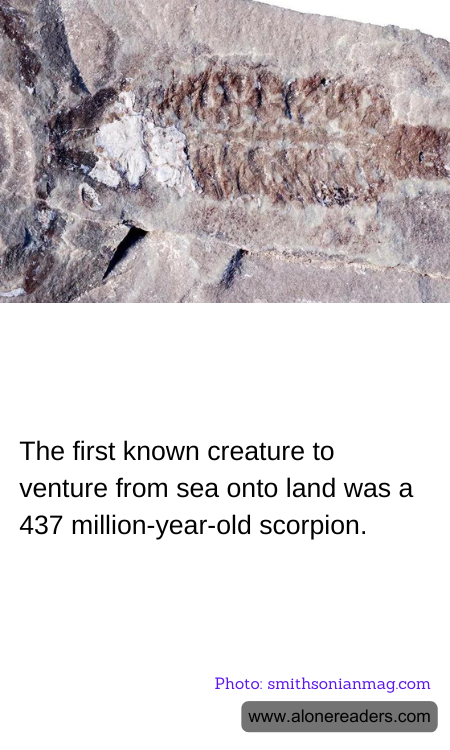
In the vast tapestry of Earth's history, the transition from sea to land marks one of the most significant evolutionary milestones. Among the pioneers of this monumental shift was a creature that might surprise many: a scorpion. Approximately 437 million years ago, during the Silurian period, the first known scorpion made its daring venture from the aquatic world onto the terrestrial landscape, setting the stage for the evolution of life as we know it today.
This ancient scorpion, known scientifically as Parioscorpio venator, represents a crucial link in the evolutionary chain. Fossil evidence suggests that these early scorpions possessed both aquatic and terrestrial adaptations, allowing them to navigate the challenging environments of both water and land. Their anatomy included features such as gills for underwater breathing and primitive lungs, or book lungs, which facilitated respiration on land. This dual capability underscores the transitional nature of these creatures, bridging the gap between marine and terrestrial ecosystems.
The journey from sea to land was not a simple one. It required overcoming numerous obstacles, such as the need for new methods of locomotion, respiration, and reproduction. The scorpion's exoskeleton, a hard protective outer layer, played a vital role in this transition by providing support and protection against the harsh terrestrial environment. This adaptation was crucial for survival on land, where the absence of buoyant water meant that organisms needed structural support to withstand gravity.
The emergence of scorpions onto land had profound implications for the evolution of life on Earth. It paved the way for the diversification of terrestrial ecosystems, eventually leading to the rise of complex plant and animal life. As scorpions and other early land-dwellers adapted to their new environment, they contributed to the development of soil and the cycling of nutrients, creating conditions that allowed plants to thrive. This, in turn, supported the evolution of herbivorous and carnivorous animals, setting off a cascade of evolutionary events that would shape the planet's biodiversity.
Today, scorpions are found in diverse habitats across the globe, from deserts to rainforests, a testament to their remarkable adaptability and resilience. Their ancient ancestors' bold move from sea to land is a reminder of the dynamic and ever-changing nature of life on Earth. It highlights the incredible journey of evolution, where even the smallest creatures can have a monumental impact on the course of history.
As we continue to explore the depths of our planet's past, the story of the first scorpion to venture onto land serves as a fascinating chapter in the narrative of life. It invites us to reflect on the interconnectedness of all living things and the intricate web of life that has evolved over millions of years. Understanding these ancient transitions not only enriches our knowledge of the natural world but also inspires us to appreciate the complexity and wonder of the life that surrounds us today.
