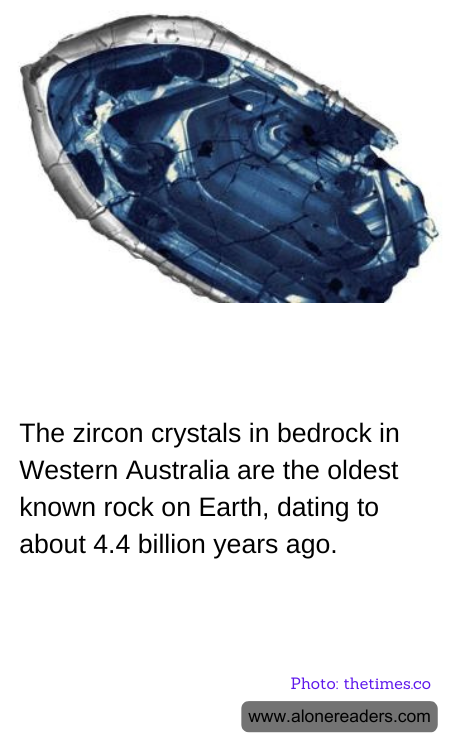
In the vast and ancient landscape of Western Australia lies a geological treasure that has captured the curiosity of scientists and enthusiasts alike: zircon crystals embedded in the bedrock, believed to be the oldest known fragments of Earth's crust. These tiny, resilient crystals have been dated to an astonishing 4.4 billion years, offering a rare glimpse into the planet's formative years and the conditions that prevailed shortly after its formation.
Zircon crystals are remarkable for their durability and resistance to weathering, which makes them excellent timekeepers of geological history. Found in the Jack Hills region of Western Australia, these crystals have survived the tumultuous processes of erosion, metamorphism, and tectonic activity that have reshaped the Earth's surface over billions of years. Their ability to endure such conditions allows scientists to study them and gain insights into the early Earth, a period that remains largely shrouded in mystery.
The discovery of these ancient zircons has profound implications for our understanding of Earth's early environment. By analyzing the isotopic composition of the crystals, researchers have been able to infer that liquid water existed on the planet's surface as early as 4.4 billion years ago. This finding challenges previous assumptions that Earth's surface was too hot and hostile for water to exist in liquid form during its early history. The presence of water is a crucial factor in the development of life, suggesting that the conditions necessary for life may have emerged much earlier than previously thought.
Moreover, the study of these zircons provides valuable information about the formation of Earth's crust. The crystals suggest that continental crust began forming relatively soon after the planet's formation, indicating that the processes that create and recycle crustal material were active in the planet's infancy. This early crust formation is a key piece of the puzzle in understanding the dynamic processes that have shaped the Earth over billions of years.
The significance of these ancient zircon crystals extends beyond their age. They serve as a testament to the enduring nature of geological materials and the stories they can tell about our planet's history. For scientists, these crystals are not just relics of the past but are vital tools that help reconstruct the early chapters of Earth's story, offering clues about the conditions that led to the development of a habitable planet.
In conclusion, the zircon crystals of Western Australia are more than just the oldest known rocks on Earth; they are windows into a time when our planet was in its infancy. Their study continues to challenge and refine our understanding of Earth's early environment, the formation of its crust, and the origins of water and life. As research progresses, these ancient crystals will undoubtedly continue to illuminate the mysteries of our planet's distant past, captivating the imagination of scientists and the public alike.
