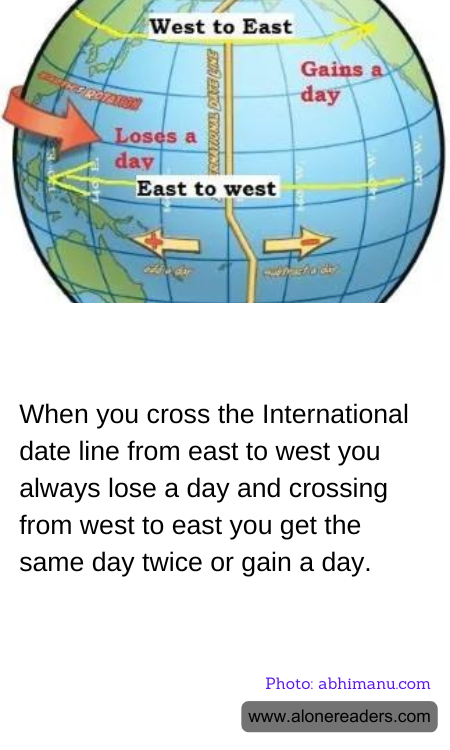
The International Date Line (IDL) is an imaginary line on the Earth's surface that runs from the North Pole to the South Pole and demarcates the change of one calendar day to the next. It is located roughly along the 180th meridian, although it deviates in several places to accommodate the political and economic affiliations of nearby countries. Crossing this line has a unique effect on the calendar date, which can be both fascinating and perplexing for travelers.
When you cross the International Date Line from east to west, you effectively lose a day. This phenomenon occurs because you are moving into a time zone that is 24 hours behind the one you just left. For instance, if you were to fly from Los Angeles to Tokyo, crossing the IDL in the process, you might leave on a Monday and arrive on a Wednesday, seemingly skipping Tuesday altogether. This adjustment is necessary to maintain a consistent global timekeeping system, ensuring that the calendar date aligns with the position of the Earth relative to the sun.
Conversely, when you cross the International Date Line from west to east, you gain a day. This means you experience the same calendar day twice. For example, if you were traveling from Tokyo to Los Angeles, you could leave on a Monday and arrive on the same Monday, despite having spent several hours in transit. This gain of a day can be a delightful surprise for travelers, offering an extra day to explore or rest, depending on their itinerary.
The concept of the International Date Line is crucial for maintaining a uniform global time system, but it can be a source of confusion for those unfamiliar with its implications. The line itself is not fixed and has been adjusted over time to accommodate the needs of various countries and territories. For instance, the line zigzags around some Pacific islands to ensure that they remain on the same calendar day as their main trading partners.
Understanding the International Date Line is essential for anyone planning to travel across the Pacific Ocean or engage in international business. It serves as a reminder of the complexities involved in global timekeeping and the importance of maintaining a standardized system that allows for seamless communication and coordination across different time zones.
In summary, the International Date Line is a fascinating aspect of our planet's timekeeping system. Crossing it from east to west results in the loss of a day, while crossing from west to east allows you to gain a day. This unique feature highlights the intricacies of our global time system and underscores the importance of this imaginary line in ensuring that our world operates smoothly and efficiently. Whether you're a seasoned traveler or simply curious about the world, understanding the International Date Line is an intriguing aspect of our interconnected planet.
